The grinder decides more about your Sunday cup than the espresso machine does, and most churches budget it backward: a few thousand dollars on a machine with a brand name a board recognizes, and whatever is left over on a grinder nobody on the committee has heard of.
We hear the same assumption in almost every equipment conversation we have with a church, whether the room is deciding to build a coffee bar for the first time or replacing something that already broke: that the machine is the purchase, and the grinder is an accessory to it. On our own consulting page we say it plainly, because it is the first correction most committees need: "the grinder, first and by a distance, because a good grinder on a modest machine beats a great machine on a bad one," and "the brand on the machine" matters less than people assume. What follows is the reasoning behind that sentence, because a claim that short deserves more than a bullet point.
Why does the grinder matter more than the machine?
Because the machine cannot fix what the grinder gets wrong, and the grinder can ruin what the machine gets right.
Espresso is brewed through a bed of grounds packed into a small basket, under pressure, for about thirty seconds. If the particles in that bed are uneven, water finds the path of least resistance through the coarser grounds and channels past them, while the finer particles over-extract in the same shot. No boiler, no pump, no PID controller downstream of the basket can even that out once it has happened. A precise, stable machine pouring water through an uneven bed just gives you a very consistent way of brewing an inconsistent shot.
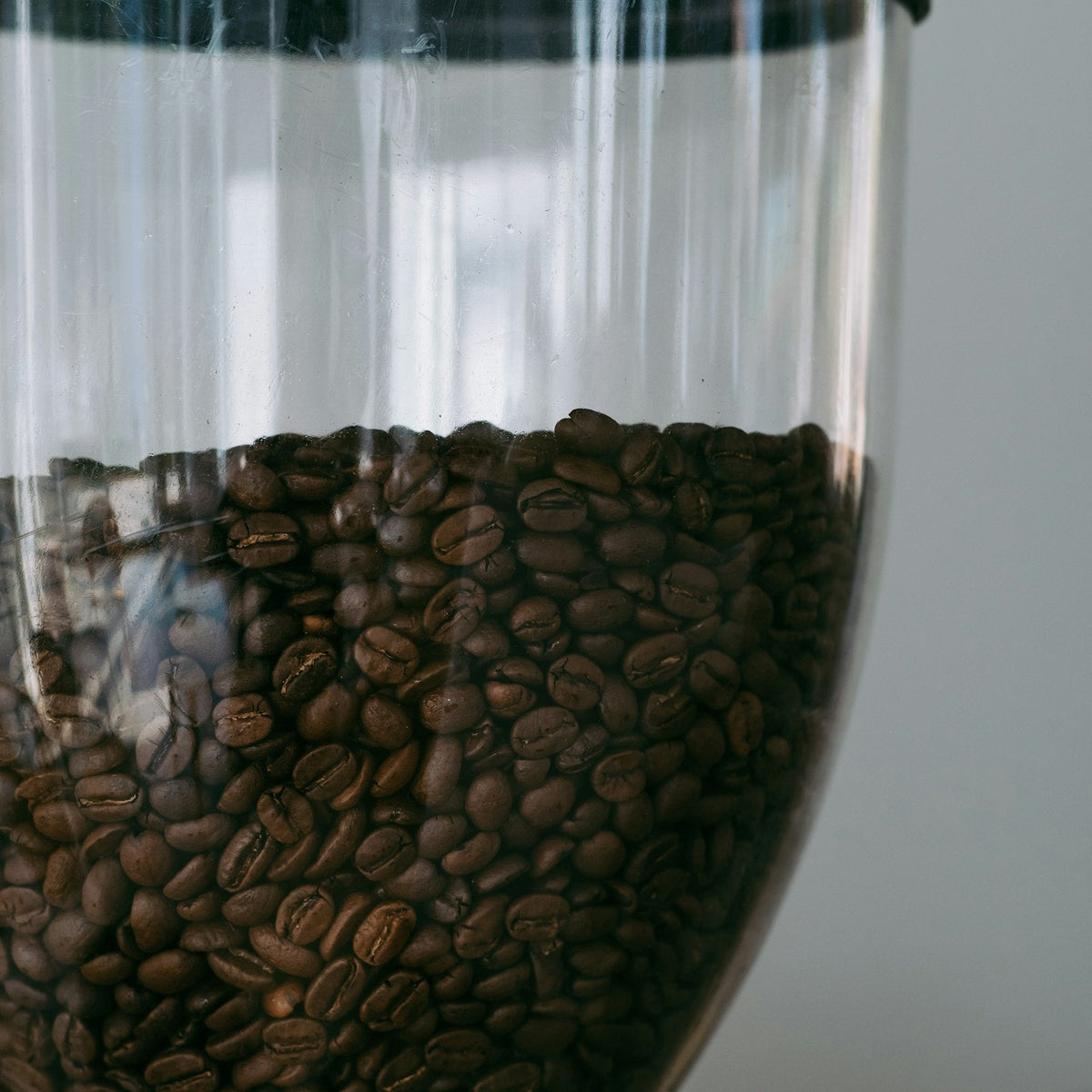
A good grinder's whole job is upstream of that problem: burrs that cut rather than crush, enough speed and torque to grind without heating the coffee, and enough consistency that the same setting gives the same grind size Sunday after Sunday. A volunteer who dials in a cheap machine against a good grinder has a real shot at a repeatable cup. A volunteer working a premium machine against a grinder that was chosen last, for whatever was left in the budget, is fighting the grind on every shot and will not know it.
Consistency you can trust without checking, and a setting a volunteer cannot easily knock out of place by accident.
A flat or conical burr set, rather than a blade, is the first line, because a blade chops unevenly by design and no amount of care fixes that. Beyond burrs, the distinction that matters for a church more than almost any other is between a grind-by-weight grinder and a grind-by-time one. Time-based grinding assumes the beans feed into the burrs at a constant rate, which drifts as burrs wear and as humidity changes how the beans flow. A grinder that weighs the dose as it grinds, stopping at a target weight rather than a target second, removes that drift entirely, which matters more in a volunteer-run kitchen than in a cafe with one trained person opening every day. Stepless adjustment, rather than a grinder with a handful of fixed click settings, is worth having too, because a seasonal change in your coffee or a new bag from a different roast can land between two clicks on a cheap grinder with nowhere to go.
None of this needs to be expensive to be right. A single-dose home-scale grinder with weight-based dosing will outperform a mid-range doser-style grinder bought mainly for its size and its logo, in exactly the way the argument above predicts.
Single-dose grinding is worth a specific mention for a volunteer kitchen, because it removes a failure mode that never shows up in a showroom demo: retained grounds. A grinder with a hopper and a doser holds coffee inside itself between uses, and that retained coffee sits and stales while the hopper above it is refilled with fresh beans, so every shot is partly old and partly new in a ratio nobody is tracking. A single-dose grinder empties itself completely between grinds, which costs a few extra seconds per drink and buys back a consistency problem most churches never knew they had, because the symptom looks like "the coffee tastes a little flat some mornings" rather than anything an untrained volunteer would trace to the grinder.
Does the brand on the machine matter?
Less than the two names suggest, once you are past the bottom of the market.
Take two machines a serious cafe might actually choose between. La Marzocco, founded in Florence in 1927, built its reputation on the Linea Classic, introduced in the 1990s and still running in cafes fifteen years after installation. Synesso, founded in Seattle in 2004 by a former La Marzocco engineer, built machines like the Hydra around independent pressure profiling for baristas who want to adjust the shot while it is pulling. Both are excellent. Neither is a notch above the other on some single quality ladder; they are different engineering answers to the same brewing problem, aimed at slightly different baristas.
That is the real content behind "the brand matters less than people assume." It does not mean the machines are interchangeable or that price is meaningless. It means that once you are choosing among machines built to hold temperature and pressure steady, you are choosing a philosophy, not climbing a ladder toward a better cup. The grinder underneath either of them is not optional in the same way.
What matters more than the brand or the automation?
Counter space, power and plumbing, and capacity for iced drinks, and churches underspecify all three in roughly that order.
A bar with nowhere to set a steaming pitcher down slows every single drink, no matter how fast the machine itself pulls a shot, because the bottleneck moves to the counter rather than the brew head. Power and plumbing are the plainer trap: a machine your building's electrical panel or water line cannot actually supply is not a machine you own, it is a machine waiting on an electrician, and that conversation is far cheaper to have before a purchase than after one arrives and will not run. Iced drink capacity is the one churches most often get wrong in the other direction, because a Sunday service in July behaves nothing like the demo in a showroom in October, and a machine or grinder sized for hot drinks alone will fall behind the moment the ice machine becomes the real bottleneck in the kitchen.
Water belongs on this list too, and it is the easiest to forget because it arrives through a pipe rather than a purchase order. Untreated water, hard or chlorinated, scales a boiler and flattens a cup regardless of what sits on top of the machine or in the hopper above the grinder. A filtration line is a smaller line item than either the grinder or the machine, and it is the one piece of equipment on this whole list that protects the other two rather than competing with them for budget. Skip it, and a church can do everything above correctly and still watch scale quietly shorten the life of whichever machine it chose, brand notwithstanding.
What does "automation" actually buy a church?
Consistency in the step it automates, and nothing in the steps it doesn't.
A volumetric dosing button, a programmable pre-infusion, a touchscreen recipe: these solve the problem of a volunteer forgetting a step or eyeballing a shot time under pressure on a Sunday morning. They are worth having for exactly that reason. What they do not solve is a recipe nobody wrote down, a grind setting nobody is checking against that morning's beans, or a volunteer who was never shown what a correct shot looks like in the cup. Automation bought to paper over a missing standard still produces an automated version of whatever that standard would have been, wrong or right.
The fix for a recipe problem is a recipe, in grams, on a card, before a single button gets programmed. Our own starting point for espresso is 18 grams of coffee in, 36 grams of liquid out, pulled in about 28 seconds, then adjusted from there against the coffee actually in front of you. That number is a starting point rather than a specification, and it is small enough to write on an index card taped inside a cabinet door. A programmable machine can hold that recipe exactly once a volunteer has it. It cannot produce it for you, and a church that skips straight to the touchscreen is automating a standard it never wrote down.

Where does the machine actually matter, then?
At volume, and on recovery, which is the honest concession to the point above.
A grinder-first budget does not mean the machine is irrelevant. On a launch Sunday, a baptism weekend, or any morning running well past your usual count, a machine that cannot hold its brew temperature steady while the steam wand is also drawing on the boiler will drift mid-service, and a volunteer with no training in reading that drift will keep pulling shots against a recipe that no longer matches the water coming out. La Marzocco built its first dual-boiler machines in the late 1970s for exactly this reason: a separate boiler for brewing and a separate one for steaming means pulling a shot and steaming milk at the same time no longer fights over the same heat. A single-boiler or heat-exchanger machine under real back-to-back demand is where the "it's just the grinder" argument runs out. If your Sunday volume is genuinely large, or growing toward it, the machine's ability to recover between drinks is worth paying for on its own terms, separately from the grinder decision.
For most churches starting or fixing a Sunday program, that volume threshold is further off than the equipment catalog wants you to believe, which is why the grinder is still the first dollar.
What if the budget doesn't stretch to both at once?
Buy the grinder new and let the machine be the one you compromise on, including buying it used.
A grinder's burrs are a wear item and its accuracy is most of what you are paying for, which makes a worn secondhand grinder a genuinely bad trade: you cannot see burr wear from a listing photo, and a grinder that has drifted out of consistency will quietly undo the whole argument above. A used espresso machine is a safer secondhand purchase by comparison, because its major failure points, a leaking gasket, a worn group seal, a tired pump, are visible, testable and usually cheap to repair, and a machine with real service history from a single prior owner can be a good instrument at a fraction of new. A church buying its first machine secondhand does not need the paddle-actuated, fully customizable profiling Synesso built its name on; that depth of control answers a question a volunteer-run bar is not asking. A dependable, well-maintained dual-boiler machine from either builder, bought used from a cafe that is upgrading rather than failing, does the one job a church actually needs: hold steady, Sunday after Sunday, without asking anyone behind the bar to think about pressure curves. Churches that buy this way almost always buy it backward: a new machine for the showroom and a used, unknown grinder to save money on the part nobody in the room will ever see. Flip it. The grinder is the one piece of equipment in this whole list where "new and modest" beats "secondhand and impressive" every time, and the machine is the one piece where the reverse can be true.
Grinder first, a stable machine second, bought new or carefully used, and automation last, bought to protect a standard you already have rather than to invent one. If you are pricing a build, our piece on what a church coffee shop costs to start works through the wider range this sits inside. If you are not building anything new yet, serving great coffee with the equipment you already have is the better place to start, because the machine you are debating may not be the constraint your program actually has. And if the honest answer is that your urn is clean and your coffee is fresh and nobody is asking for an upgrade, that is a fine place to stay; equipment conversations should follow a real limitation, not precede one, and a limitation you have actually watched happen on a real Sunday is worth more than any spec sheet.
Pricing a grinder for your program? We carry a small range ourselves, including the Baratza Sette 270Wi, a grind-by-weight grinder built around the same discipline this article argues for: a repeatable setting a volunteer can trust. See the full range in our coffee grinders collection. If you would rather talk through the whole equipment list before buying anything, including whether a machine you are eyeing secondhand is worth the asking price, that is what our consulting is for, and it is the same conversation whether you are starting a program or fixing one. Supply once you are brewing is coffee for churches.