What Does a Coffee Importer Actually Risk?
A green coffee importer absorbs carrying cost and price risk before any roaster says yes to a lot. What that risk actually costs, in one real decision.


Your cart is empty
Where coffee comes from and how it reaches Pensacola: producing countries, varieties, processing methods, and how we buy and import green coffee.
83 articles
A green coffee importer absorbs carrying cost and price risk before any roaster says yes to a lot. What that risk actually costs, in one real decision.
Anacafé cut Guatemala's 2026-27 coffee export forecast from 4.2 million to 3.8 million quintals on El Niño, after 2025-26 exports rose 15% to 4.28 million quintals and...
Brazil exported a record 287,300 metric tons of green coffee in October 2026, 4.79 million bags and 23.3% more than a year earlier, while the average export price fell...
A green coffee offer sheet lists lots, scores, and prices up for sale. What saying yes to a line actually commits a buyer to, and why we still cup every sample before ...
Colombia's coffee federation reported October 2026 production of 1.114 million bags, down 8%, and a 12-month total of 12.56 million bags, down 15%, as the government s...
The 'C price' in every market report is a benchmark, not what a lot of green coffee costs. What a coffee differential actually is, with real green-coffee and exchange-...
A Sucafina report released 4 November 2026 forecasts a 9.3% fall in Central American and Mexican coffee output for 2026/27, while Costa Rica's growers expect a crop 10...
December arabica futures fell 5.12% between 2 and 5 November 2026 to a five-week low, as analysts pointed to Brazilian supply and certified stocks stayed near record l...
Fermenting coffee with wild microbes is the default. A growing number of producers add a chosen yeast strain on purpose, and two peer-reviewed studies measure exactly ...
Uganda's September 2026 coffee report shows exports of 735,435 bags and a 2025/26 coffee year of about 8 million bags, with robusta down and arabica up.
The Philippine Department of Agriculture and Nestlé Philippines signed an agreement on 23 October for a coffee genetic resource and planting program in Northern Mindan...
Most explanations credit Lactobacillus for a lactic-processed coffee's creamy tang. A 2019 peer-reviewed study says the real story runs through two different bacteria,...
Coffee traders at the Swiss Coffee Trade Association's 1 October forum named war as their main concern, swissinfo reported on 22 October 2026. Vietnamese coffee bound ...
London's November robusta contract lost more than 5% in the week to 23 October 2026 as certified robusta stocks rose to about a one-year high. December arabica gave ba...
The top coffee at the Best of Rwanda 2026 online auction sold for US$452 a kilogram on 21 October 2026, a record high, The New Times reported on 22 October.
H1 Centroamericano and EC16 gave the highest yields in a World Coffee Research and CIAT trial of 32 arabica varieties at 30 sites in 17 countries, Daily Coffee News re...
Colombia exported 8.45 million bags of coffee from January to September 2026, down 13.8%, and exporters said a stronger peso cut their income, La República reported on...
Ethiopia could lose US$160 million to US$453 million in coffee export earnings if EU deforestation rules shut out part of its EU-bound coffee, ODI Global said in a bri...
Growers in Vietnam's Central Highlands told Reuters on 19 October 2026 that this season's coffee crop should match last season's, and that El Niño drought threatens th...
A 2022 study found a sealed anaerobic coffee fermentation is dominated by different microbes than the lactic acid bacteria popular coffee writing usually credits for it.
New York arabica's December contract closed at 315.70 US cents a pound on 19 October 2026 after two straight gains, with short covering and thin certified stocks cited...
Producers on India's Malabar Coast hold green Arabica and Robusta in humid monsoon air for twelve weeks to six months on purpose, and two academic papers and a governm...
A Colombian lab trial compared pineapple-inoculated and spontaneous coffee fermentation and found real chemical differences, and why one farm, three tasters, and an un...
A natural Geisha from Fazenda Santuário Sul in Carmo de Minas, Brazil, sold for US$200 a pound at the Alliance for Coffee Excellence's Legends auction in Tokyo on 16 O...
Kenya's Nairobi Coffee Exchange opened its 2026/27 season with two sales on 6 and 13 October that sold 17,084 and 15,072 bags, averaging US$293 and US$287 a 50-kilogra...
Dole Food Company Hawaii has listed its Waialua coffee farm on Oahu for sale, with about nine jobs ending on or about 30 November 2026, according to a WARN notice rece...
How a hundred-pound lot of green coffee actually clears US Customs and FDA prior notice before it reaches a small roaster, and what that process costs.
The University of Hawaii at Mānoa will lead the new Feed the Future Innovation Lab for Coffee and Cacao, the State Department said on 15 October 2026, with $8 million ...
One 1920s arabica-robusta cross gave coffee its rust resistance. The genetics behind Catimor, Sarchimor, and two coffees on our own shelf, explained.
Peru exported US$705 million of coffee from January to August 2026, Mincetur said on 14 October. The exporters' association ADEX counted US$701.74 million for the same...
Italy's Foreign Ministry launched the Global Coffee Initiative on 14 October 2026 with the World Bank Group and CDP, which said it aims to mobilize at least US$500 mil...
Sơn La, which holds nearly half of Vietnam's arabica area, broke ground on a coffee processing plant on 11 October 2026 during its second coffee festival, Nhan Dan and...
A 2004-05 FAO/ICCRI trial measured exactly how fast mold risk builds in wet-hulled Sumatran coffee, and what the extra days in wet storage cost in the cup.
Coffee growers from Portuguesa and Lara protested outside Café Amanecer and Grupo Botalón in Araure on 12 October 2026, saying the roasters pay below the prices agreed...
Costa Rica's coffee growers say the strong colón is forcing job cuts, and ICAFE board president Fernando Naranjo told The Tico Times on 7 October 2026 that growers rec...
Liberica and excelsa were treated as one species on paper since 2006. A 2025 genomic study says that was wrong, and names a third, largely unknown coffee species: Coff...
Colombia produced 12.65 million bags of coffee in the October 2025 to September 2026 coffee year, down 15%, according to National Federation of Coffee Growers figures.
The ICO's composite coffee price averaged 262.18 US cents per pound in September 2026, down 8.7% from August, as Brazil's record crop reached the market, the ICO repor...
El Niño is still strengthening, the US Climate Prediction Center said on 8 October 2026, as drought pushed Central American arabica premiums to about three-year highs,...
A 2024 microbiology study traces exactly what takes over a honey-processed coffee bed while it dries, bacteria first, then yeast, and shows why "no fermentation tank" ...
Kenyan coffee sold at the Nairobi Coffee Exchange earned Ksh 41.63 billion across 770,034 bags in the 2025/26 season, KBC Digital reported on 7 October 2026.
Carbonic maceration borrows wine's 'intracellular fermentation' claim, but the one peer-reviewed study on coffee cherries never actually measured it.
Brazil exported 3.93 million bags of green coffee in September 2026, up 20.4% on a year earlier and the most in 20 months, according to Secex data published on 6 October.
Uganda exported 737,766 bags of coffee in August 2026, 13.6% fewer than a year earlier, according to the country's monthly coffee report for August.
Arabica coffee futures in New York fell 6.7% across September 2026, to 290.70 US cents a pound on the December contract, Safras & Mercado reported on 2 October 2026.
Peru's National Coffee Board expects the 2026 harvest to fall 18% to 22% to between 220,000 and 230,000 metric tons, Agraria reported on 1 October 2026.
A coffee cherry has five layers around its seed and usually two of them inside. What happens to the fruit after picking is why the same shelf can hold both a washed an...
Five coffee varieties, Geisha among them, are entering Rwanda's formal release process after eight years of field trials, World Coffee Research announced on 30 Septemb...
Honduras exported 7.3 million sacks of coffee in its 2025-26 coffee year and earned $2.285 billion, according to the Honduran Coffee Institute, as volume rose 19.3% an...
Vietnam exported 15.4% more coffee from January to September 2026 and earned 7.3% less for it, as the average export price fell 19.7%, according to its Ministry of Agr...
The International Coffee Organization launched the Coffee Market Intelligence Platform on 30 September 2026, a free tool that puts its price, trade, production and con...
A landrace isn't wild coffee and it isn't a named variety like SL-28. It's a crop population farmers keep reselecting without a formal breeding program, and it's what ...
Arabica's December contract closed at 288.75 cents a pound on 28 September 2026, up 3.6%, after touching three-month lows the week before. Comunicaffe tied the move to...
Conab's third survey of the cycle put Brazil's 2026 coffee crop at a record 67.6 million bags, with arabica up 34.8% and conilon down 6.6%. Here are the figures from C...
Robusta is not a variety of arabica. It is Coffea canephora, a separate species with half the chromosomes and a different way of making seed, and it is also one of ara...
A varietal is the kind of coffee plant the seed came from. The harder question is what that name is standing in for, because the same line on a bag can hold a named se...
Mucilage is the coffee cherry's sticky inner layer, and it is 84 percent water over a pectin gel rather than the sugar coating everyone describes. What it is made of, ...
Green coffee has come down hard from its 2025 record and the shelf price has not followed. What drove the spike, why retail lags, and how specialty lots are actually p...
Growing higher raises the sugar in a coffee seed by a large, measurable amount. Elevation is standing in for temperature, and the grade on the bag certifies the farm r...
Three of the naturals on our shelf share one processing record and taste nothing alike. The reason is that almost none of the fruit's own flavor crosses into the seed.
Three documents travel with a lot of green coffee on its way into the country, and one of them has an 8-hour deadline. What the route is, and how long it takes.
Nobody certifies direct trade, and every page on the subject tells you to ask a roaster. We're one, we buy through importing partners, and we publish what we paid per ...
Every sort between the tree and your kitchen is aimed at the unripe seed, and the pale bean in your bag got past all six of them. That makes it the one piece of eviden...
Four commercial methods remove caffeine from green coffee, and they differ only in what does the pulling. Here is what each one does, and the residual limit the field ...
Natural process names an operation performed at origin. Four naturals on one shelf run from mango and papaya to milk chocolate and roasted almond, which is what the wo...
Kenya's grading letters measure the bean, not the cup. Here is how the country description holds up against one bag we actually bought, published notes and all.
The region on an Ethiopian label is a trading habit that outlived its system. Four specifications decide the cup instead, and a good listing publishes all of them.
Peru is planted to older trees than almost anywhere else, and that single fact runs through everything: the yields, the rust, the organic certification, and the price ...
El Salvador built its name on washed Bourbon. What the country plants and dries now has moved further than the guides describing it, and our own lot is the proof.
Brazil grows more coffee than anyone else, which is why the word on the bag spans a wider range of quality than any other origin. Two reputations, both honestly report...
Colombian coffee is arabica grown across roughly twenty departments on three Andean ranges. What Supremo and Excelso actually mean, how the cup shifts by region, and w...
Sumatra Ribang Gayo runs banana, spiced rum and cedar over a heavy body. Pour over at 1:15 to 1:18, or a coarse French press at 1:12 for more weight.
Java Bukit Paniisan from Indonesia tastes of cocoa, peach and warm spice. Grind sizes by method, a 1:15 to 1:17 pour over ratio, and storage tips.
East Africa Nya-Nye decaf is made with the chemical free Swiss Water Process. What stays in the cup, how much caffeine is left, and the grind to use.
Washed Burundi from Kigina hill runs blackberry, fig and dark chocolate. Grind, water temperature and ratio settings for V60, Chemex and French press.
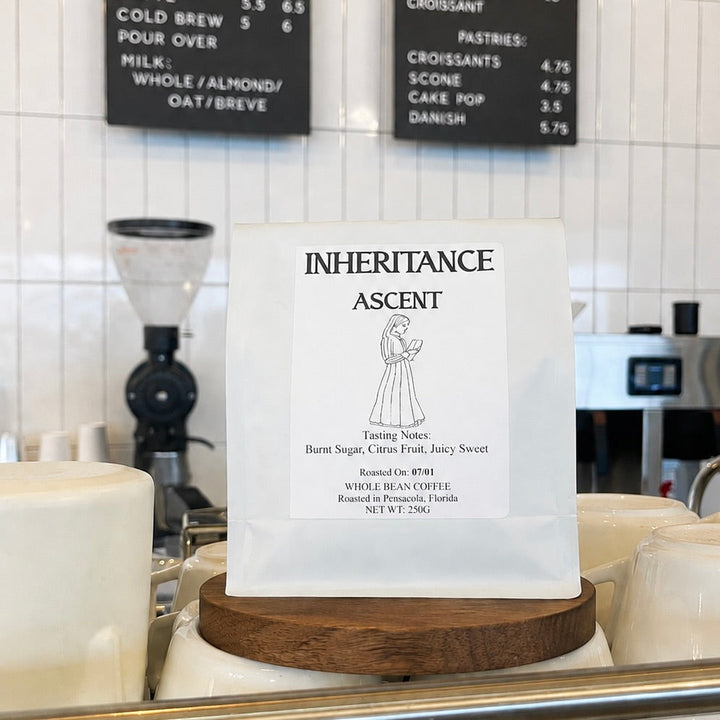
ASCENT is the Inheritance house blend: burnt sugar, citrus and juicy sweetness. Espresso and filter ratios, plus why it holds its shape in milk.
Ethiopia Gerba Dogo comes from smallholders in the Guji zone: floral, stone fruit, clean finish. Brew it on a V60 or Chemex in about three minutes.
Ethiopia Birbirsa is a natural process light roast grown near 2100 meters: granola, mango, orange. Brew it on a V60 or Chemex at 1:15 to 1:16.
Ethiopia Yabitu Koba is a natural process heirloom lot from a smallholder collective: cooked peach, apricot, dates. Brew at 1:15 to keep the fruit.
Kenya Nyeri Ndaroini is a washed lot of SL-28, SL-34, Ruiru-11 and Batian: spiced sugar, red berry, ginger. Pour over at 1:16 with a 40 second bloom.
Nyeri Kamoini is a washed Kenyan from SL-28, SL-34 and Ruiru 11 smallholders. Peach and apricot, with 20 g to 300 ml as a starting pour over recipe.
Ethiopia Dambi Uddo is a natural process community lot from Guji: chocolate syrup, chai spice and blueberry. Brew at 1:15 to 1:17 on a V60 or Kalita.
Heirloom coffee refers to Ethiopia's thousands of native wild varieties. What the term really means, how heirloom cups taste, and whether it signals quality.