The world price of coffee has fallen roughly nineteen percent from the record it set in February 2025, and the bag on your grocery shelf has barely moved. Green coffee peaked at a monthly average of 354.32 US cents per pound in February 2025, the highest monthly figure ever recorded, and by August 2026 it had come back to 287.29 cents. Over a comparable stretch, the average US retail price for ground roast coffee went from $6.12 a pound in January 2024 to $9.72 in April 2026, and it was still $9.30 in August 2026 — down about four percent from its own peak while the raw material fell almost five times as far.
So the honest answer to why coffee is still expensive has two halves. The market did spike, for reasons that are documented and mostly agricultural. And the shelf price is coming down far more slowly than it went up, which is a well-described feature of how coffee prices travel rather than a mystery.
How much has the price of coffee actually gone up?
The number to watch is the composite indicator price published monthly by the International Coffee Organization, an intergovernmental body whose market reports are the closest thing the trade has to a public scoreboard. The ICO tracks it in US cents per pound of green, unroasted coffee.
The shape of the last two years, taken from their reports:
- February 2025: 354.32 cents. The highest monthly average on record, past the previous high of 305.13 cents set in March 1977. The daily reading touched 375.00 cents on 13 February 2025.
- September 2025: 324.62 cents. Still historically extreme, and up more than nine percent on the month before it.
- June 2026: 248.90 cents, with a single day at 231.96 cents on 9 June, which the ICO called the lowest level in nearly two years.
- August 2026: 287.29 cents. Off the floor again, and about nineteen percent below the February 2025 peak.
Those are averages across every kind of coffee traded, and the spread underneath them is wide. In August 2026 the ICO's group indicators put Colombian Milds at 387.46 cents, other washed arabicas at 361.31, Brazilian naturals at 322.24 and robustas at 180.63. A Colombian washed lot and a Vietnamese robusta are not competing for the same buyer, and they never move together.
Why did it go up?
Weather, mostly, and then the thinness that weather leaves behind.
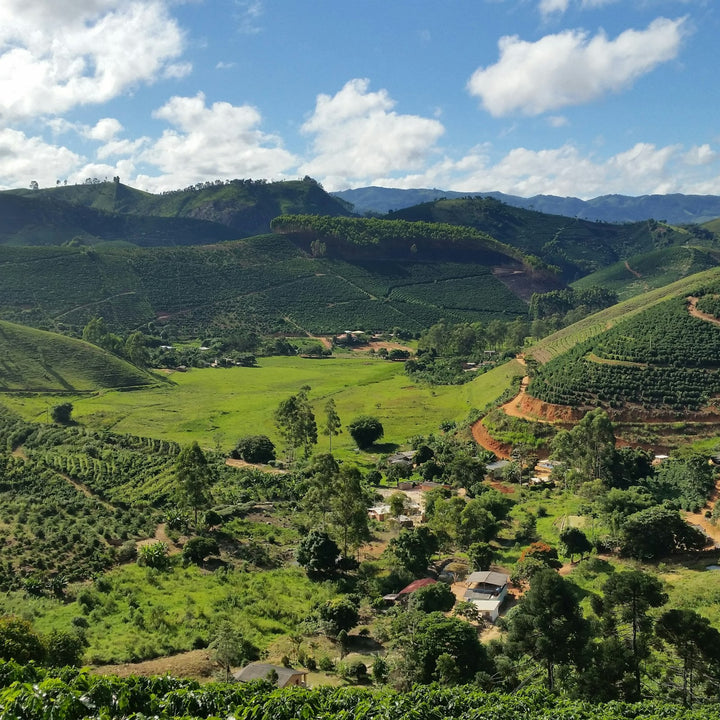
The USDA Foreign Agricultural Service publishes a twice-yearly production and trade circular that is the best free accounting of where the world's coffee actually is. Its reading of the recovery is specific: Brazilian arabica for 2026/27 is forecast at 47.5 million 60-kilogram bags, up 9.5 million, because "timely rainfall during flowering in September and October ensured favorable fruit development and near-record yields in Minas Gerais." That sentence is worth reading twice, because the five years before it were the opposite — flowering rain that never arrived on time, in the single region that sets the world's arabica supply.
The other half is stocks. Exchange-certified warehouses hold the coffee that backs the benchmark, and they ran down hard. The ICO recorded certified arabica stocks in New York at 0.24 million bags in August 2026, the lowest since 1999. When the deliverable pile is that thin, a forecast of bad weather moves the price more than the weather itself ever would, because there is no cushion between a scare and a shortage.
And then the correction, which is the part almost nobody mentions: the high prices paid for the crop that ended them. USDA's note on Vietnam is that "recent high prices allowed coffee growers to increase expenditures on fertilizers and other inputs to boost yields." Growers who could suddenly afford fertilizer used it. World production for 2026/27 is forecast at a record 189.7 million bags, up 10.8 million, with ending stocks rising for a second consecutive year. The spike financed the supply that broke it, which is how commodity markets have always worked and is cold comfort to anybody who farmed through the bottom of the last cycle.
So why hasn't my coffee gotten cheaper again?
Because retail prices are sticky on the way down, and this is measured rather than suspected.
The US Bureau of Labor Statistics has tracked the average city price of ground roast coffee since 1980. Its series, published through the St. Louis Fed, reads $6.12 a pound in January 2024, $7.02 in January 2025, a peak of $9.72 in April 2026, and $9.30 in August 2026. That is still fifty-two percent above where it started, at a moment when the green market had given back nearly a fifth of its gain.
The mechanism is described plainly in the Coffee Barometer, the sector report Sjoerd Panhuysen and Frederik de Vries have published for years: "farmgate prices rise more slowly than retail prices, but fall more sharply," and price transmission in coffee is "structurally asymmetric." Credit them for the finding; it is theirs and it holds up.
The practical reasons are not sinister. A roaster buying green in 2026 is often drinking down contracts signed in 2025 at 2025 prices, so their cost base lags the headline by months. Packaging, freight, labor and card fees all rose too and none of them came back down. And a business that raised prices twice in eighteen months and apologized for it both times is slow to reprice a third time on a market that has already faked a bottom once this year.
Is specialty coffee priced the same way?
No, and this is where the headline number stops being useful.
The benchmark prices an average, anonymous, deliverable coffee. A named lot with a cup score attached is sold on its own merits, and the best public record of what those merits fetch is the Specialty Coffee Transaction Guide, built by researchers at Emory University's Goizueta Business School out of roughly 105,000 real contracts covering more than two billion pounds of green specialty coffee. Price discovery for specialty belongs to them, and the numbers below are theirs.
Their 2024 edition reports, for the 2023/24 harvest year, a median free-on-board price of $3.50 a pound, with the middle half of contracts running from $2.76 to $4.68. Sorted by cup score, the same year looks like this:
- 80 to 81.9 points: median $2.29 a pound
- 85 to 85.9 points: median $3.61 a pound
- 88 points and above: median $8.82 a pound
Eight cupping points is a near fourfold difference in price, in the same dataset, in the same year. If you have ever wondered why one bag is fourteen dollars and the one beside it is thirty-two, that table is most of the answer, and it has very little to do with what the market did last month.
Free on board is a specific point in the journey, and the Guide is careful about it: FOB prices cover "any overland transportation costs from mills or warehouses to the port of origin, but not any overseas shipping, insurance, or any transportation, customs, and overland freight costs incurred on arrival." So an FOB median and what a small American roaster pays an importer are two different quantities, measured in two different places. We have written about what a published price does and does not prove and about the quantities green coffee is actually sold in, and both are worth reading beside this.
There is a floor under some of it. Fairtrade International raised its minimum price for washed arabica to $2.00 a pound effective 1 December 2026, with a $0.20 premium on top and a further $0.40 for organic. Their own announcement contains the most candid line in the whole subject: coffee "has not fallen below $2.00 since March 2024." A floor that the market has not touched in two and a half years is a safety net, not a price.
How much of what I pay is the coffee?
Nobody can tell you, and the institution best placed to know says so in print.
The ICO's Coffee Development Report 2020 states that "there is a lack of systematic data on supply chain practices, prices, costs and margins at different levels along the C-GVC, thus hampering transparency," and recommends that somebody build the mechanisms to collect it. Six years on, they haven't been built. Any percentage you see for how a retail coffee dollar splits between farmer, exporter, roaster and shop is somebody's estimate wearing a number's clothing, and we're not going to add one.
What a roaster can do is publish its own half. We put what we paid for the green coffee on each coffee's page. Ethiopia Hambela Buku cost us $7.60 a pound green, and that figure sits on the product page next to a 92.3 cup score. The cost of publishing it is that the number is permanent and specific: it is dated to one lot from one harvest, it does not move when a headline moves, and anybody can see the occasions we paid over the odds for a coffee that didn't earn it. We think that trade is worth making, and it is also the reason a customer can hold us to a number when most of the chain publishes nothing at all.
Here is where we are honestly the wrong answer. If you are buying coffee on price per pound, a supermarket will beat us and it won't be close — their green is bought by the container, ours by the sack, and no amount of care on our end closes a gap built that far upstream. Buy the cheap coffee. It's a rational decision and we won't pretend otherwise.
What should I actually do about it?
Three things, in order of how much they save.
Stop throwing coffee away. Stale beans and over-filled brew baskets waste more money than any price increase in this cycle. Buy the size you will finish in three or four weeks rather than the size with the better unit price.
Buy on score and process, not on the news. A coffee's price tracks its cup score and its lot size far more tightly than it tracks the monthly benchmark, so a well-chosen 88-point coffee at a fair price is a better purchase in an expensive year than a hedged guess at a cheap one.
If you run a cafe, reprice on your own costs and say so. Customers accept an increase explained with a reason and resent one that arrives silently. We have written separately about building a menu price from the drink up, which is the arithmetic that survives a volatile year.
Key takeaways
- Green coffee hit a record monthly average of 354.32 US cents a pound in February 2025 and was at 287.29 cents in August 2026, about nineteen percent below the peak.
- The spike was driven by five years of badly timed rain in Minas Gerais and by exchange stocks that fell to their lowest level since 1999.
- High prices funded the fertilizer that produced a record 2026/27 crop, forecast at 189.7 million bags.
- US retail ground coffee peaked at $9.72 a pound in April 2026 and was still $9.30 in August, because retail prices fall more slowly than they rise.
- Specialty lots are priced on cup score, not on the benchmark: 88-plus coffees had a median FOB price of $8.82 a pound in 2023/24 against $2.29 for 80-point coffee.
- No credible source publishes how a retail coffee dollar divides along the chain, and the ICO has said the data does not exist.
Common questions
Is coffee cheaper now than it was in 2025?
Wholesale green coffee is. The ICO composite indicator price averaged 354.32 US cents a pound in February 2025 and 287.29 cents in August 2026, a fall of about nineteen percent. Retail prices have moved much less: US ground roast averaged $9.72 a pound in April 2026 and $9.30 in August 2026.
Why did coffee prices rise so much in 2024 and 2025?
Chiefly weather in Brazil, where five consecutive seasons of poorly timed rainfall during flowering held arabica yields down in Minas Gerais, combined with exchange-certified stocks falling to their lowest level since 1999. A thin deliverable stock makes the price react violently to any forecast of further trouble.
Will coffee prices come back down?
Wholesale prices already have, partly. The USDA forecasts world production at a record 189.7 million bags for 2026/27 with stocks rising for a second year, which is the condition under which prices usually ease. Retail prices historically follow, slowly and incompletely.
Does the world coffee price tell me what a bag of specialty coffee should cost?
Not closely. The benchmark prices an average, anonymous, deliverable coffee, while a named lot is priced on its cup score and its lot size. The Specialty Coffee Transaction Guide records a median FOB price of $8.82 a pound for coffees scoring 88 and above in 2023/24, against $2.29 for coffees scoring 80 to 81.9.
How much of a bag of coffee's price is the green coffee?
There is no reliable public figure. The International Coffee Organization's Coffee Development Report 2020 states that systematic data on prices, costs and margins along the coffee value chain is lacking, and recommends it be collected. Any percentage quoted for this split is an estimate rather than a measurement.
What does FOB mean on a green coffee price?
Free on board is the price for coffee delivered and placed onto the ship at the port of origin. It includes overland transport from the mill or warehouse to that port, and excludes ocean freight, insurance, customs and any inland freight after arrival.
Ethiopia Hambela Buku is a dry-process lot scoring 92.3, and its green cost is published on its page alongside the rest of what we know about it. See the coffee and what we paid for it, or read more on where our coffee comes from and how we buy it.