War is now the top concern for the companies that move much of the world's coffee, according to a survey of participants at the Swiss Coffee Trade Association's annual forum on 1 October 2026 and reported by swissinfo.ch on 22 October. Participants named "war" as their main worry and "flexibility and alternative routes" as their first priority, the outlet reported. The association says its members, a list that includes Nestlé, Starbucks, Sucafina, Olam, COFCO and Louis Dreyfus, handle more than half of the coffee traded across borders. The reporting, by Anand Chandrasekhar, describes traders rerouting ships, paying surcharges and holding larger stocks of green coffee. Daily Coffee News carried the story in its weekly round-up on 23 October.
Why are coffee ships going around Africa?
The shortest sea route between Asia and Europe runs through the Red Sea and the Suez Canal, and swissinfo reported that it is effectively closed to this trade. Vietnamese coffee bound for Europe now sails around the Cape of Good Hope instead. A senior executive at a European shipping company, who spoke to swissinfo on condition of anonymity, said the detour adds 20 days of transit time, or close to three weeks.
The same report said the conflict in the Middle East, including the disruption around the Strait of Hormuz, has not cut coffee trade volumes by much. What it has done, according to the people swissinfo interviewed, is force carriers onto longer routes and add fuel surcharges to the bill.
The size of the delay depends on what is being measured. Coffee Network, the StoneX market service, put the extra distance of the Cape route at 3,000 to 3,500 nautical miles and 10 to 14 days of sailing in a 17 April 2026 note by managing editor Alexis Rubinstein. A second Coffee Network note on 27 April estimated that rerouting added 25 to 30 days to end-to-end transit, which counts port calls and transshipment as well as sailing time.
What does a longer voyage cost?
The April notes put numbers on the bill. Coffee Network reported on 17 April that spot rates from Shanghai to Rotterdam had risen 23% in a week to about $3,850 per twenty-foot container, the highest since October 2025, roughly $750 more per box than in late March. It cited the Freightos Baltic Index for Asia to the US West Coast, where rates stood nearly 40% above late February at more than $2,400 per forty-foot container. A twenty-foot container carries about 275 to 320 bags of green coffee of 60 kg each, according to European Coffee Federation loading figures reported by Comunicaffe on 21 October. On our arithmetic, the $750 increase works out to roughly $2.30 to $2.70 per bag.
Insurance is the other line. Coffee Network's 17 April note quoted war-risk cover at 0.2% to 1.0% of a vessel's insured hull value per voyage, which it said meant $200,000 to $1 million extra for each transit of a $100 million ship. Swissinfo reported in October that insurers are expected to keep adding war-risk premiums and that shippers are likely to pass them on to traders as surcharges.
Longer voyages also tie up working capital, because coffee that has been paid for sits in a container for weeks before it can be sold, and swissinfo reported that traders are holding larger inventories to cover the gap.
What are coffee traders doing about it?
Swissinfo quoted three industry figures by name. Dany Barkha, global head of logistics at the Geneva trader Sucafina, said the companies coping best are the ones that prepared early. José Luis Pérez, head of commodities at Commodity Supplies AG, a freight broker in Schwyz that the outlet said has about 200 coffee customers, said supply-chain priorities have moved from efficiency to resilience and will next move toward adaptability.
Nestlé, one of the largest buyers, has described the cost from its side. The company said price increases made up 4.7% of its coffee sales growth in the first half of 2026, swissinfo reported, and the company expects lower green coffee prices in the second half to be partly offset by higher transport and energy costs. That is the company's own expectation, not a measured result.
How much coffee crosses borders?
The International Coffee Organization's Coffee Market Report for September 2026 estimates world production in the 2025/26 coffee year at 183.6 million 60-kg bags, against consumption of 180.6 million, a surplus of 3.0 million bags after four years of deficits. The same report shows 113.66 million bags of green coffee exported from October 2025 through August 2026, up 0.8% on the year before. Swissinfo, citing ICO data, reported that 77% of the coffee harvested in 2025 was exported along 246 trade routes, with the busiest running from Brazil, Colombia and Vietnam to Europe and the United States. Our earlier report on the ICO's September market report covers the price side of the same document.
- About 20 extra days for Vietnamese coffee routed around the Cape of Good Hope (a European shipping executive, via swissinfo, 22 October 2026)
- About $3,850 per twenty-foot container, Shanghai to Rotterdam, up 23% in a week (Coffee Network, 17 April 2026)
- 113.66 million bags of green coffee exported, October 2025 to August 2026 (ICO, September 2026 report)
- Suez Canal transits forecast to recover to 80% of pre-diversion levels by February 2027 (Drewry, via swissinfo, 22 October 2026)
When could the Suez route recover?
The maritime research firm Drewry estimates that Suez Canal transits will recover to 80% of their pre-diversion levels by February 2027, swissinfo reported. That is a forecast, and it rests on events in the region rather than in the coffee market.
Among the coffees on the Asia to Europe lane is robusta from Vietnam, the subject of our report on the 2026/27 Vietnamese crop. Brazil's shipments, which reach Europe without the Suez Canal, faced a different set of problems earlier in the year: Coffee Network's 27 April note cited Cecafé figures showing Brazilian exports down more than 21% on the year in the first quarter of 2026, and pointed to congestion at the port of Santos. Our report on Brazil's September 2026 exports reports the later figures, and our explainer on why coffee is still so expensive covers the price background.
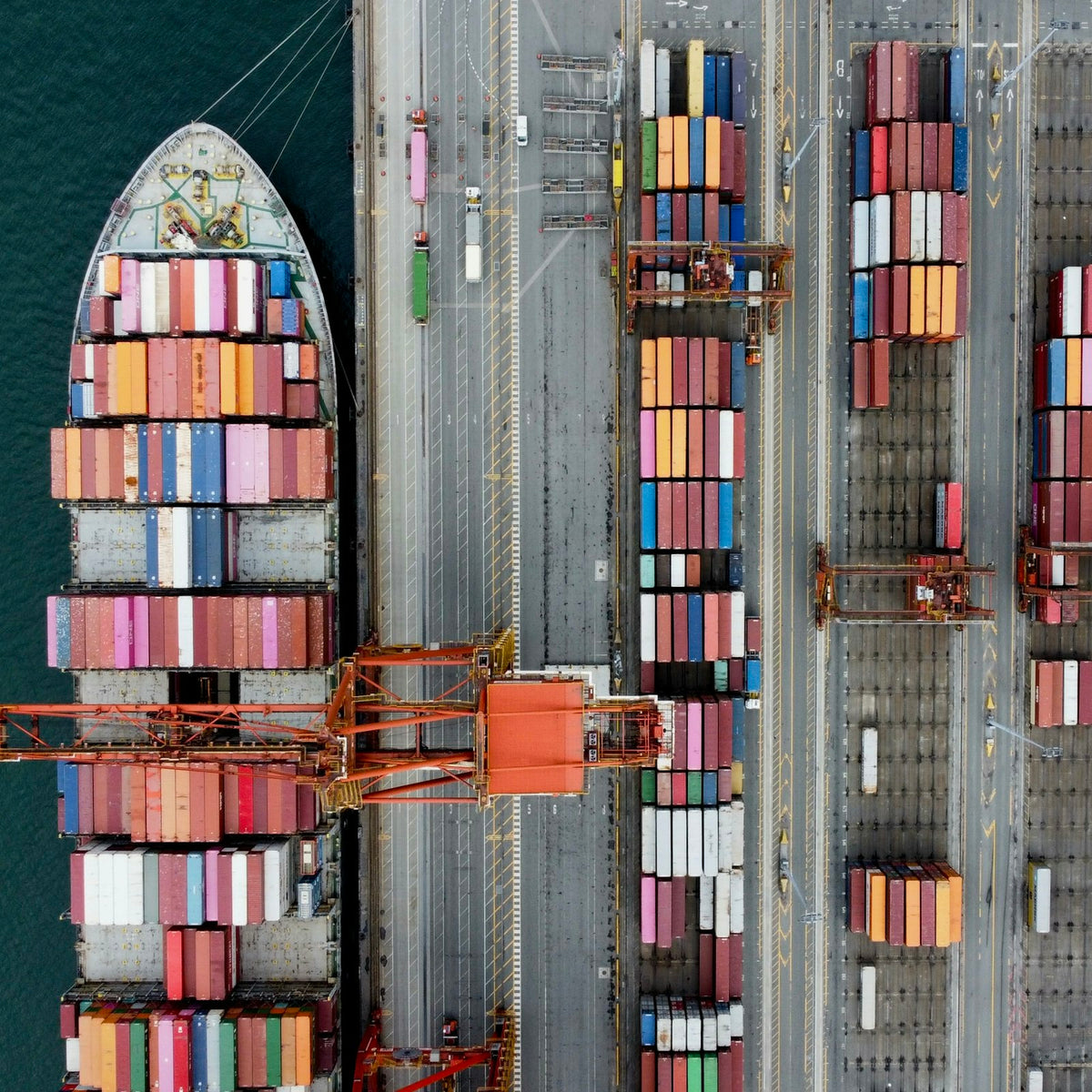
Photograph: Daniel Miksha, Unsplash. A container ship at the Port of Vancouver, Canada, used to show the kind of vessel that carries green coffee; it is not a coffee shipment.