Arabica coffee futures fell for three sessions in a row this week, and the December contract on ICE Futures US closed at 277.15 US cents per pound on Thursday 5 November, according to the session report by Guilherme Dorigatti of Notícias Agrícolas. That close was 14.95 cents, or 5.12%, below the 292.10 cents the same contract settled at on Monday 2 November, the outlet reported. Comunicaffe described Thursday's close as a new five-week low.
The losses came one session at a time. Notícias Agrícolas reported that the December contract lost 2.79% on Tuesday 3 November, then 4.20 cents, or 1.48%, on Wednesday 4 November to settle at 279.75 cents, and a further 2.60 cents on Thursday. A daily market report posted on the website of Uganda's coffee authority, dated 6 November, printed the same Thursday settlement of 277.15 cents and the same 2.60-cent move. Two separate records, one number.
Robusta did not follow. The January robusta contract in London rose US$13 to US$3,241 per metric ton on 5 November, after a US$18 gain to US$3,228 on 4 November, both figures reported by Notícias Agrícolas and matched in the Uganda report.
How far has arabica fallen since October?
On 19 October, the December contract closed at 315.70 cents, as Notícias Agrícolas reported at the time and as our report on that two-day jump recorded. The 5 November close is 38.55 cents lower, a fall of about 12.2% in a little under three weeks, by our arithmetic from those two published settlements.
Put in terms a buyer of green coffee sees, a 60-kilogram bag holds about 132 pounds. Taking the settlement Notícias Agrícolas reported for 5 November, that bag comes to roughly US$367 on the futures screen by our arithmetic, and the three sessions from 2 to 5 November took about US$20 off it. Physical coffee trades at a premium or discount to that screen price, so the figure is a reference rather than what any roaster pays.
The International Coffee Organization publishes a monthly measure instead. The ICO said on its website that its composite indicator price averaged 262.18 US cents per pound in September 2026, down 8.7% from August. The October figure had not been published when this was written, and the composite blends several coffee types, so it is not the same series as the New York contract.
What are analysts pointing to?
The outlets that covered the week pointed to supply from Brazil. Notícias Agrícolas cited analysis from Barchart and a recent Rabobank report on expectations of larger Brazilian exports and a possible rebuilding of stocks held outside the country. Hedgepoint Global Markets analyst Laleska Moda, quoted by Notícias Agrícolas on 5 November, said that a weaker Brazilian real had offset part of the fall in dollar prices for Brazilian sellers, but that broader fundamentals remained bearish. That is her firm's analysis, not a measured outcome.
Hedgepoint also cited preliminary Cecafé data showing export certificates for more than 5 million bags issued through 30 October, with about 4.9 million already shipped, according to the same report. Cecafé's full October report had not been published on its export reports page when we checked on 6 November; the most recent there was September's, at 3.894 million bags.
Estimates of the crop behind those shipments differ. Comunicaffe reported on 6 November that an Icafé analysis of 15 statistical sources puts Brazil's 2026/27 production at 72.75 million bags, 16.6% above the previous harvest, which would be a record. Brazil's own agency, Conab, published 67.6 million bags in its September survey, as we reported then. Both are estimates, and they differ by about 5 million bags.
Across the whole market, Comunicaffe reported on 3 November that Icafé's median of five forecasters (Ecom, Hedgepoint, NKG, Rabobank and the USDA) points to a world surplus of 9.68 million bags in the 2026/27 coffee year. That is a forecast. The ICO's own balance for 2025/26, published in its September report, showed a surplus of 3.0 million bags.
Why has the fall not been steeper?
Notícias Agrícolas named certified stocks as the counterweight. ICE certified arabica stocks stood at 220,917 bags on 2 November, Comunicaffe reported, close to the record low of 217,646 bags set in mid-September. Barchart's figure for 3 November, cited by Notícias Agrícolas, was 220,379 bags, with 55,396 bags of Brazilian coffee waiting to be graded. Those warehouses hold about half a day of world consumption, by our arithmetic against the ICO's 2025/26 estimate of 180.6 million bags a year.
Fabiano Teixeira Odebrecht, a coffee trader interviewed by Notícias Agrícolas on 3 November, said that tight stocks and firm demand were still supporting prices, and that the market tends to react upward to any problem with a crop. He was speaking about price behavior, not forecasting a level.
For robusta, the Uganda report cited India's Coffee Board cutting its 2026/27 estimate by 5% to 380,000 metric tons after a below-normal monsoon, a figure Comunicaffe also reported. The Board's own website did not load for us on 6 November, so that figure rests on those two reports.
Earlier context on robusta's own swing in late October is in our report from 24 October.
- Arabica December, 2 November close: 292.10 US cents per pound, as reported by Notícias Agrícolas, 5 November 2026
- Arabica December, 4 November close: 279.75 US cents per pound, down 1.48%, as reported by Notícias Agrícolas, 4 November 2026
- Arabica December, 5 November close: 277.15 US cents per pound, down 2.60 cents, as reported by Notícias Agrícolas and the Uganda daily report, 5 and 6 November 2026
- Robusta January, 5 November close: US$3,241 per metric ton, up US$13, as reported by Notícias Agrícolas and the Uganda daily report, 5 and 6 November 2026
- ICE certified arabica stocks, 2 November: 220,917 bags, as reported by Comunicaffe, 3 November 2026
- ICO composite indicator, September average: 262.18 US cents per pound, as reported by the ICO for September 2026
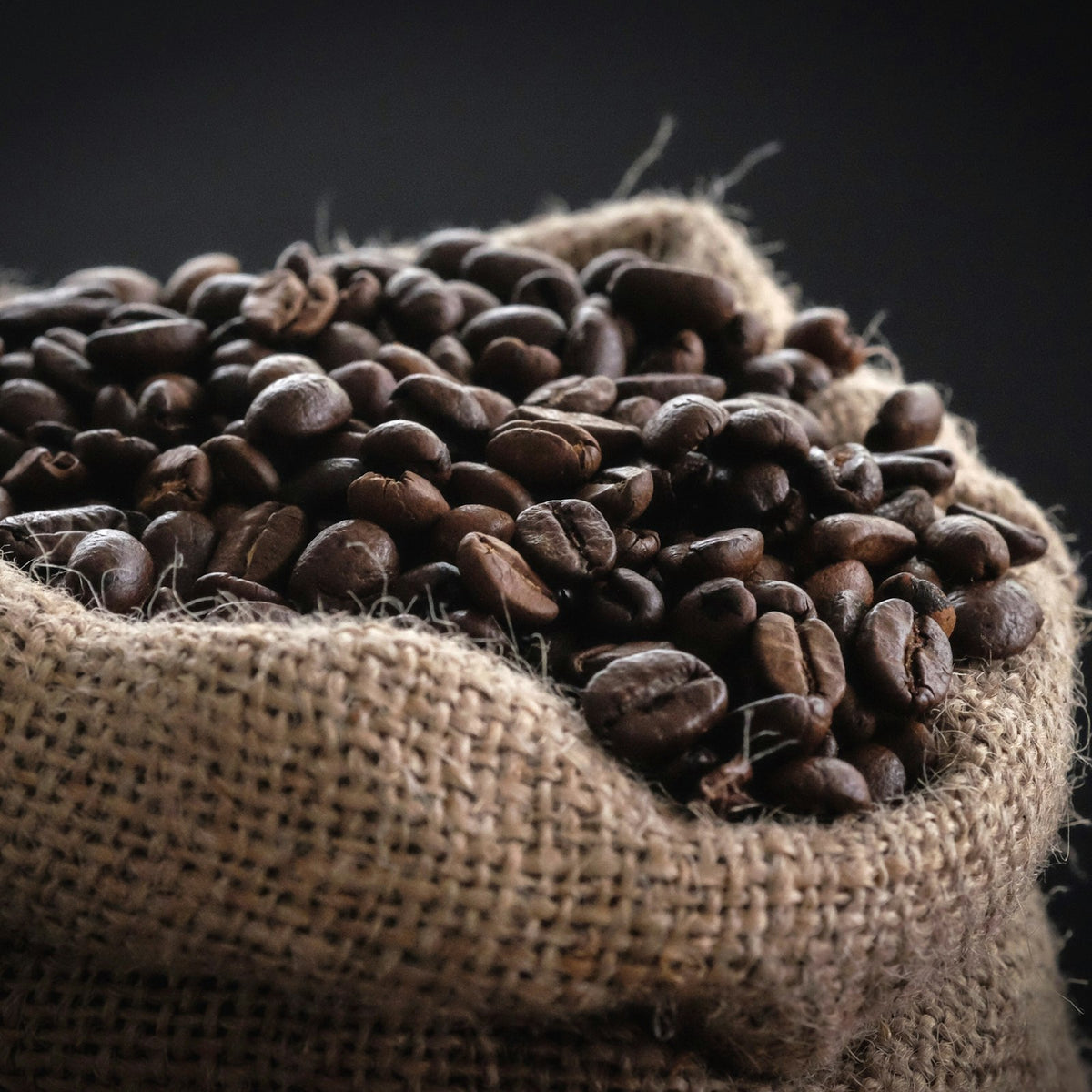
Photograph: Tina Guina, Unsplash. Coffee beans in a sack, photographed in Manila; not coffee traded on ICE.