A coffee importer once emailed me introducing his company and asking if I'd buy from it. I appreciated the hustle. I wanted to say yes. The coffees tasted like other things I already had on my shelf from neighboring countries, which is not unusual and not a problem by itself. The problem was price. By the time that lot would have landed at my roastery, it would have cost somewhere around $12 a pound green, and everything else I was actually choosing between that week sat in an $11 to $12 band. Shipping was worth roughly $2 to $3 of that number. That gap is the whole reason I said no to a coffee I otherwise would have been glad to carry.
Those are one deal's numbers, from one week, for one lot I'm not going to name. They are not a rule about what freight costs on any other coffee, and I would be doing readers a disservice if I let anyone quote them back as a freight rate. What they are is a clean look at the thing nobody asks about when they ask why a roaster buys through an importer instead of going direct: somebody has to carry the coffee, and carrying it costs money whether or not the roaster on the other end ever says yes.
The Short Answer Leaves Out the Part That Costs Money
We've already answered why roasters buy through importers instead of buying direct, and the short version holds up: volume, credit, logistics and sample access. A small roastery buys in pounds, not containers, and an importer is the reason a few sacks of one lot are available at all instead of a whole container nobody our size could use.
That answer is true and it is not the interesting part. It describes what an importer does for a roaster. It does not say what an importer is actually taking on to be able to do it, which is the part that shows up in a price rather than in a service description.
What an Importer Is Actually Holding
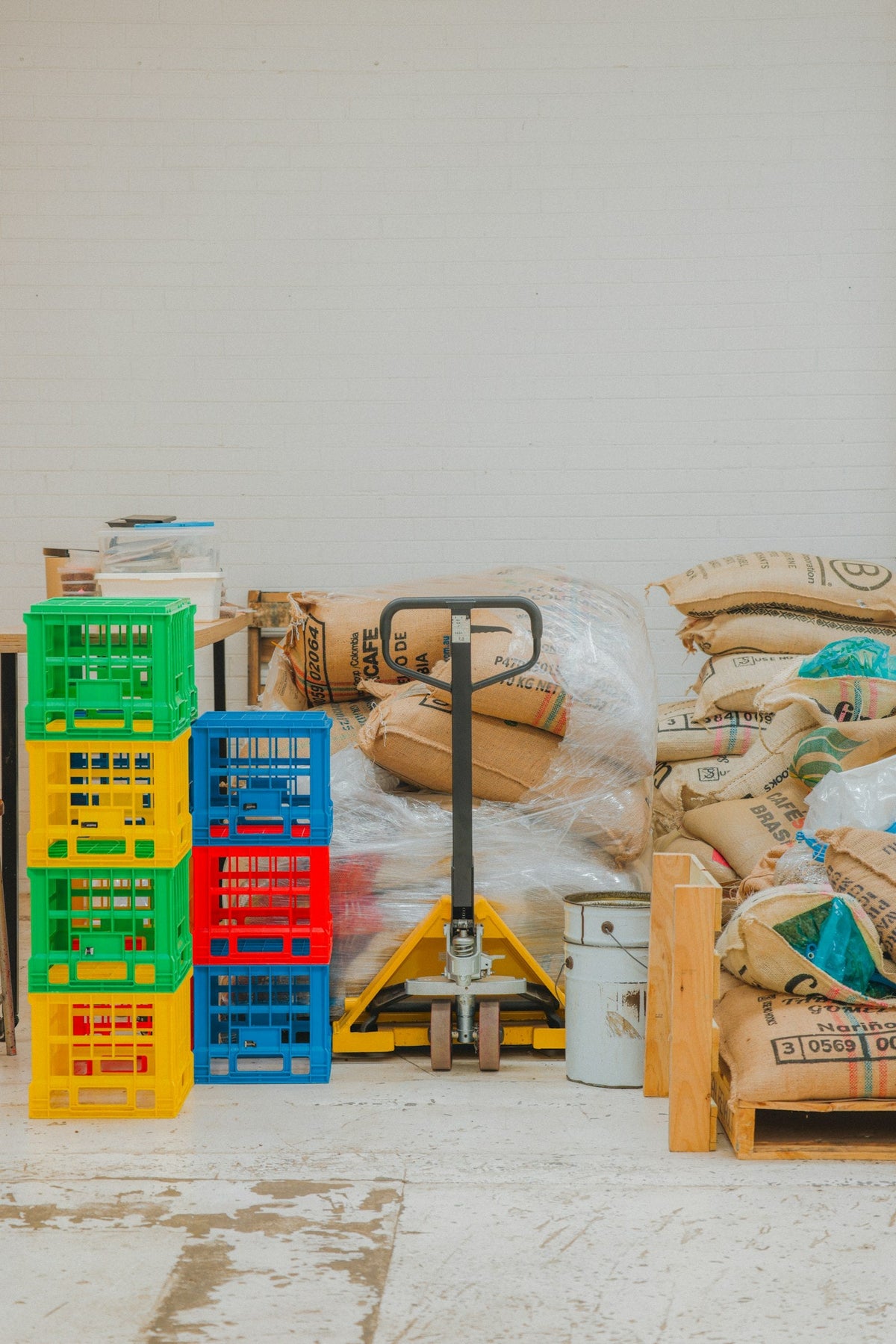
A green coffee importer commits to a lot, in most cases, before any one small roastery has agreed to buy it. The coffee is shipped, cleared through customs, warehoused, and offered out in workable quantities, and all of that happens on the importer's balance sheet, not ours. If a lot doesn't sell as fast as expected, or the market moves against it, or a roaster backs out after a sample doesn't match, the importer is still holding green coffee that cost real money to land and store. That is carrying cost and price risk, and it is what a small roaster is actually paying someone else to absorb when the roaster buys in 1, 2, 5 or 20-pound quantities instead of by the container.
Royal Coffee, which is itself a green coffee importer, has written about what a green coffee supplier actually does for a roaster, and Perfect Daily Grind has laid out the tradeoffs between forward and spot coffee buying from the buyer's side of that same risk. Both are worth reading if you want the general mechanism explained by people who either run it or report on it for a living. A forward contract, in plain terms, is a roaster agreeing to buy a lot before it has even shipped, which moves some of that carrying risk onto the roaster early in exchange for a better price; a spot purchase leaves the importer holding it until somebody says yes. We're not re-explaining either case in full. What we can add is the part that happened to us, on our own ledger, when that risk didn't pencil out.
This Isn't the Same Number as a Coffee Differential
It's easy to confuse carrying cost with the differential we've written about separately, so it's worth keeping the two apart. A differential is what two sides agree a specific lot is worth above or below that day's futures benchmark, fixed at the moment they lock a price. Carrying cost is a different question entirely: it's what it costs somebody to hold the coffee, insure it, warehouse it and finance it between the day they committed to a lot and the day a roaster like us actually says yes to it. A differential can be fixed and fair, and the lot can still turn out to be a bad one to carry if it sits unsold longer than expected. The two numbers answer different problems, and an importer is managing both on every lot at once, not just one.

When the Risk Didn't Pencil Out
That is the coffee from the opening. I was not being asked to evaluate whether it was good. I tasted it and it was perfectly fine, in the same range as other things from nearby origins I already had access to. I was being asked to decide whether it was worth more than the coffees already sitting in that price band, once everything it took to get it to Pensacola was added in. It wasn't. The margin between what I'd have paid and what I was already paying for coffee I already liked was thin enough that the extra two or three dollars a pound for getting it here made the decision for me.
I don't think that importer did anything wrong, and I don't think the coffee was bad. I think the carrying cost on that particular lot, in that particular week, didn't leave enough room underneath it for a roaster my size to say yes. That's the arithmetic an importer is managing on every lot they hold, not just the one that happened to land on my desk. Most of the time it works out in favor of a sale. That week, for that coffee, it didn't.
What We Give Up by Buying This Way
Buying in small lots through an importer isn't free of its own cost to us, either. We almost certainly pay more per pound than a roaster large enough to commit to a container would pay for the same quality, because somebody absorbed the carrying cost of getting a few dozen pounds of it to a 20-pound buyer instead of a 40,000-pound one, and that cost is in the price we see. We also don't know, on most of our own lots, whether the per-pound green figure we publish already has that carrying cost folded into it or whether it sits on top as a separate line. We've been honest about that gap before, and it's still open. What we do know is which number we actually paid and which coffee it bought, and that's the number we stand behind.
The tradeoff is real in both directions. We get sample access, a workable minimum, and no container sitting on our own books waiting to sell. The importer gets a committed customer for product they're already carrying. Neither side is doing the other a favor. Both sides are pricing a risk, and the lot from the opening is the one where my half of that math came out no.
A Coffee That Cleared That Bar
Not every lot gets turned down. Our Organic Peru Decaf, scoring 88.4 and carrying notes of dried strawberry, dark chocolate and berry jam, is one of the single-origin lots on our shelf right now that cleared the same carrying-cost math the opening coffee didn't. It came to us the same way, through the same importing partner, Sweet Maria's, a company that has been doing exactly this kind of small-roaster-sized sourcing since it was founded in 1997.
If you want to see what else this buying relationship covers, we've written separately about how much green coffee you actually have to buy at once. Direct trade skips the importer, and the risk they were carrying goes somewhere else, usually back onto the roaster or the farm. Buying through one, the way we do, means somebody is pricing that risk before it ever reaches us, and most weeks, that's worth paying for.