El Niño is still strengthening, the US Climate Prediction Center said in its diagnostic discussion of 8 October 2026, and it put the chance of a strong to very strong event lasting through January to March 2027 at greater than 83%. The same week, Reuters reported on 8 October 2026 that premiums for arabica from Honduras, Guatemala, El Salvador and Nicaragua had reached or neared their highest levels in about three years, after a drought the agency linked to El Niño. The forecast and the price report landed on the same day.
What did the Climate Prediction Center say on 8 October?
El Niño is the periodic warming of the eastern tropical Pacific that shifts rainfall around the world. The center, part of the US National Oceanic and Atmospheric Administration, kept its El Niño Advisory in place on 8 October 2026 and said that "El Niño continues to strengthen." It reported the Niño-3.4 index, the ocean temperature reading it uses to track the event, at +2.1°C, and said sea surface temperatures in parts of the eastern equatorial Pacific were running more than 4.0°C above normal.
The discussion also gave odds that the event becomes historically large, measured as a three-month average index of +2.5°C or more. The center estimated that chance at 54% for September to November 2026, 83% for October to December and 70% for November 2026 to January 2027. Those are forecasts, not measurements, and the center published them as probabilities.
The October statement follows the center's 10 September 2026 discussion, which said there was a greater than 90% chance of a very strong event through the Northern Hemisphere fall and winter, as we reported in our 2 October piece on Vietnam's coffee exports. The two statements describe different thresholds and different months, so they are not a like-for-like comparison. The center's next scheduled update is 12 November 2026.
How dry is Central America?
The drought peaked in July and August across the Dry Corridor, the band of land running through El Salvador, Guatemala, Honduras and Nicaragua, according to the Reuters report by May Angel and Diego Oré, which Investing.com Brasil and Forbes Brasil both published on 8 October 2026. Reuters reported that aid agencies have warned of a food crisis, because somewhere between 3 million and 5 million subsistence and small farmers lost staple crops such as beans and corn.
Coffee has fared better than those crops, Reuters reported, because it is a perennial plant rather than one sown each season. Marc Schonland, an independent coffee consultant, told Reuters that Central America is exceptionally dry, and said that this could be an early sign of what a severe El Niño does.
What has the drought done to Central American coffee prices?
A premium, or differential, is the amount a buyer pays above the futures price for a particular coffee. It reflects quality as well as supply and demand. Reuters reported on 8 October 2026 that premiums for Honduran, Guatemalan, Salvadoran and Nicaraguan arabica were at or near three-year highs, citing its own price data.
Central America supplies about 15% of the world's arabica, Reuters reported on 8 October 2026, which is roughly one bag in every seven. The experts Reuters spoke to said the high premiums are setting a floor under world futures prices. That is their analysis of the market, and the report did not give a figure for how large the effect is.
The early crop numbers point lower. Reuters reported that initial forecasts for the 2026/27 harvest show Honduran output down 7% and Guatemalan output down 10%, and that both countries have said they may cut those estimates further. The two produce about two-thirds of Central America's coffee, Reuters reported. Honduras closed its 2025-26 coffee year on 30 September with export volume up 19.3%, according to the Honduran Coffee Institute's figures in our story on its 2025-26 coffee year, so the forecast describes the next crop rather than the one already shipped.
How did coffee futures move this week?
New York arabica swung hard in both directions. Comunicaffe reported on 7 October 2026 that the December contract rose nearly 4.1% on 6 October to settle at 304.45 US cents a pound, its first close above $3 since 1 September. Comunicaffe credited a stronger Brazilian real and technical factors, and wrote that concerns over El Niño remained in the background.
The next session took most of that back. Notícias Agrícolas reported on 7 October 2026, in a story by Guilherme Dorigatti, that December arabica fell 11.75 cents, or about 3.86%, to 292.70 cents, and that November robusta in London fell $105 to $3,485 a ton. The outlet tied the fall to more Brazilian coffee reaching the market, after September exports from Brazil hit their highest monthly volume in 20 months, which we covered in our report on Brazil's September exports. It added that the market is still watching El Niño as a source of volatility.
A daily market report dated 8 October 2026, posted on Uganda's government coffee website, shows the same 292.70 and $3,485 settlements for the 7 October session. That report described growing conditions in Brazil and Vietnam as beneficial and noted above-normal rain in Brazil during flowering. Both reports describe settled prices on named days, not a price for this morning.
- Greater than 83%: the Climate Prediction Center's chance of a strong to very strong El Niño through January to March 2027 (discussion of 8 October 2026)
- 83%: the center's chance that October to December 2026 averages +2.5°C or more on its index (same discussion)
- About 15%: Central America's share of world arabica supply, as Reuters reported on 8 October 2026
- Down 7% and down 10%: the initial 2026/27 output forecasts for Honduras and Guatemala, as Reuters reported on 8 October 2026
- 304.45 US cents a pound: December arabica's settlement on 6 October 2026, as Comunicaffe reported on 7 October
- 292.70 US cents a pound: December arabica's settlement on 7 October 2026, as Notícias Agrícolas reported that day
For the wider picture on prices, see our explainer on why coffee is still so expensive.
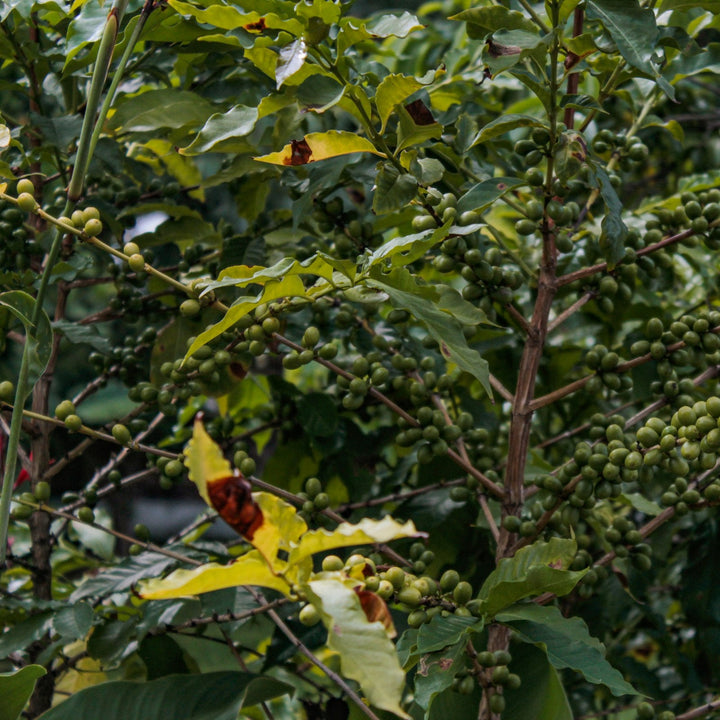
Photograph: Gerson Cifuentes, Unsplash. Taken in Tajumulco, Guatemala.