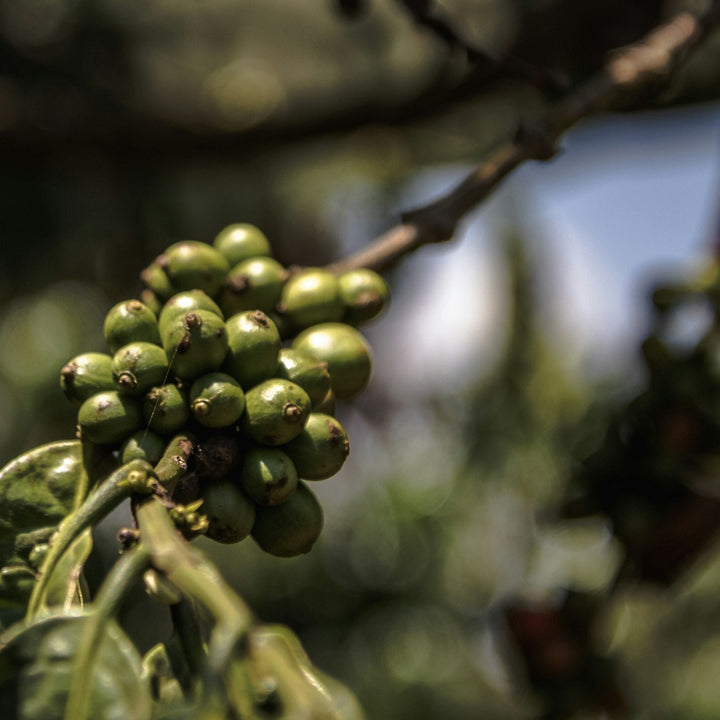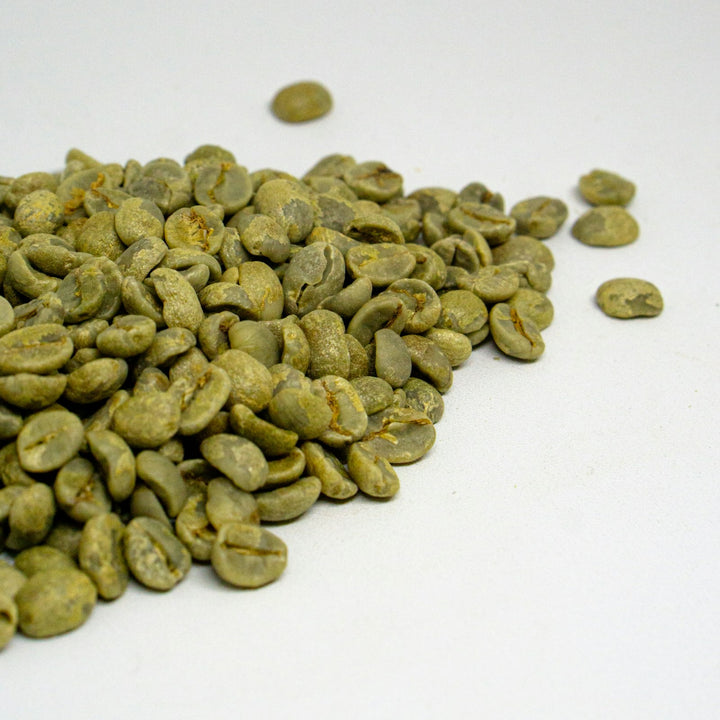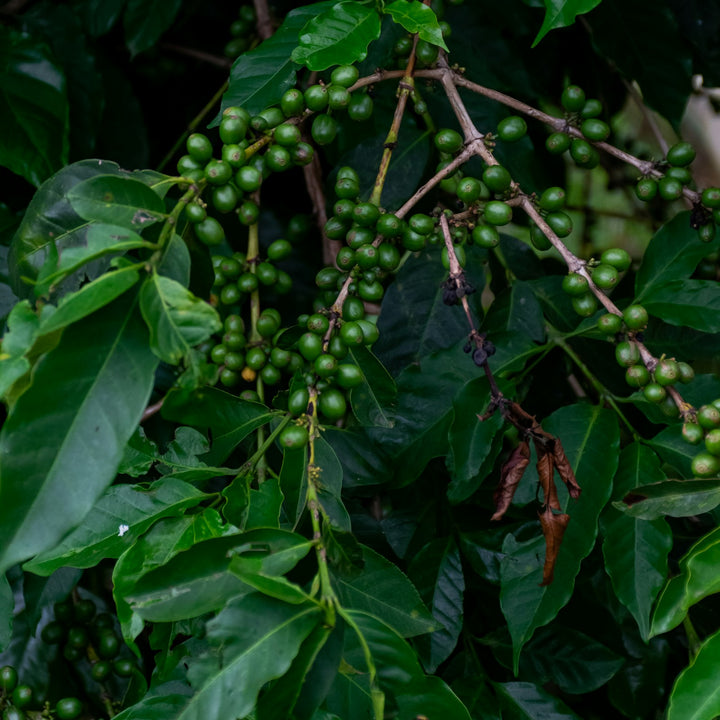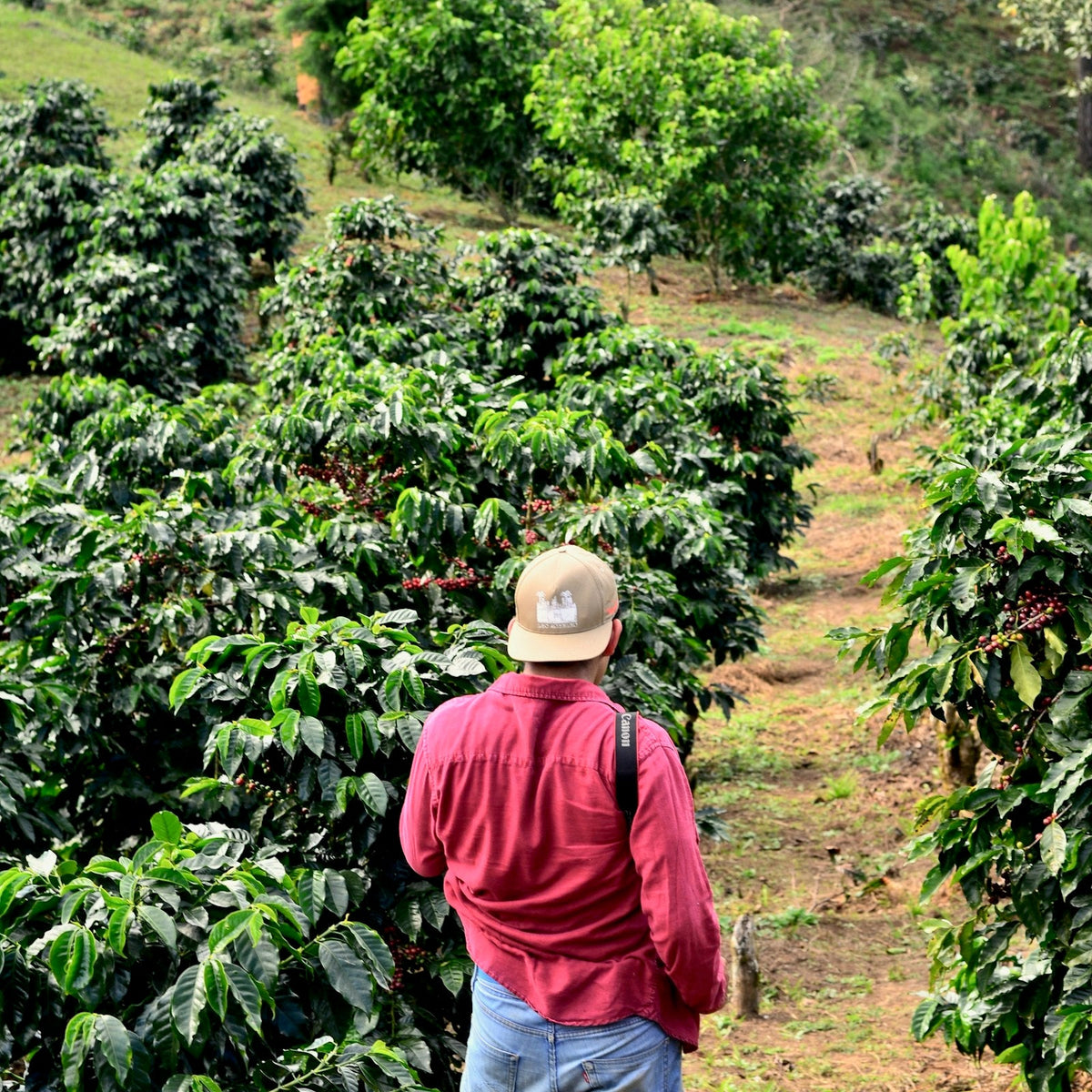
Peruvian coffee is Arabica grown by smallholder families on the eastern slopes of the Andes and down into the high Amazon, mostly washed, mostly certified organic, and planted to older varieties than almost any other origin. It isn't one flavor — the supermarket bag and the specialty bag share a country and very little else.
Key takeaways
- Over 90 percent of Peru's coffee grows on plots smaller than five hectares, and an estimated 223,000 families depend on it as their primary income.
- More than 70 percent of Peru's planted area is Typica and another 20 percent is Caturra, two varieties World Coffee Research rates as very highly susceptible to coffee leaf rust.
- Peru is the world's leading exporter of organic coffee, with approximately 90,000 hectares certified.
- Our own Peru lot is a naturally processed decaf from San Martín that cups 88.4 after decaffeination.
Peru grows coffee on the eastern Andes, on farms most countries would not call farms
Coffee in Peru is a smallholder crop, and the scale is worth stating plainly. In its Coffee Annual for Peru, report PE2025-0018, dated 21 May 2025, the USDA Foreign Agricultural Service records over 90 percent of the country's coffee growing on plots smaller than five hectares, with an estimated 223,000 families relying on it as their primary income. About 75 percent of the crop sits between 1,000 and 1,800 meters.
Production concentrates in the north and center: Cajamarca at 22 percent, San Martín at 20 percent, Junín at 19 percent and Amazonas at 15 percent. The harvest runs April through September, with roughly 85 percent of it picked between April and July.
Our own lot comes from San Martín, from the Cerro Blanco Producers Association, founded in 2020 by local coffee-growing families in La Victoria to reach specialty buyers directly. It's the only coffee on our Peru page, which is the honest scale of what a small roastery buys from an origin this size. Our guide to Colombian coffee covers the neighboring origin.
Peru is planted to older trees than almost anywhere else, and that single fact runs through everything
Almost every page written about this origin prints the same variety split, and almost none of them says what follows from it. USDA FAS puts Peru at over 70 percent Typica, followed by Caturra at 20 percent, with everything else making up the last 10 percent. Typica is the oldest cultivated Arabica in commercial use.
Now read that beside the agronomy. World Coffee Research's Arabica variety catalog gives Typica "very high susceptibility to coffee leaf rust," and gives Caturra the same rating alongside "good yielding potential of standard quality in Central America." Peru is roughly ninety percent planted to two varieties that the industry's own reference catalog flags as very highly susceptible to the disease that damages it most.
The consequences sit in the same FAS report. Rust is now impacting nearly 40 percent of the crop. Coffee borer persists below 1,500 meters. Average yields run 721 kilograms per hectare, while well-managed plantations reach up to 45 bags, or 2,700 kilograms, per hectare. That's a fourfold gap inside one country.
It's the exact inverse of Ethiopia. Heirloom coffee there means thousands of native varieties nobody has catalogued or named. Peru's heirlooms are catalogued, named, and still in the ground because nothing has replaced them. Our own bag carries three of them: Bourbon, Caturra and Typica.
Almost all of Peru's coffee is washed, and the bag on our shelf is not
FAS describes Peru's coffee as primarily processed using water to wash the beans, hand-picked and sun-dried. That's why nearly every guide to the origin prints the same profile: clean, balanced, chocolate and caramel.
Ours is recorded on the store as natural process, patio-dried, the whole cherry dried with the fruit still on it. Its published notes read Dried Strawberry, Dark Chocolate, Berry Jam, Sarsaparilla and Banana Milk. A national pattern and one lot are not a contradiction: processing moves a cup further than a border does, and what the word natural actually predicts is less than most bags imply.
Peru leads the world in organic coffee, and that is a fact about farm economics before it is a fact about taste
FAS states it plainly: Peru is the world's leading exporter of organic coffee, with approximately 90,000 hectares certified. Set that beside the farm-size figure and the reason stops being romantic. Certification is one of the few things a five-hectare farm can do to reach a buyer who will never fly out to meet it.
It's also what puts Peruvian coffee on a supermarket shelf at a price that has nothing to do with specialty. Sweet Maria's, whose green-buying library is the one page in this field we'd send a reader to, makes exactly that criticism: the cheapest certified-organic Peru on the market is a different product from a carefully picked lot. We think they're right.
Our position is that certified organic is a floor rather than a verdict, and we still cup against it before we buy. Our organic shelf holds exactly one coffee, which is what applying that standard costs us.
We bought the most expensive green on our shelf and then took the caffeine out of it
We paid $8.90 per pound for this coffee green, the highest of the coffees on our shelf that publish a green price, and then we sent it away to have the caffeine removed. Decaffeination costs money and it doesn't make a coffee better, so the only route to a decaf worth drinking is to buy green worth decaffeinating. That was the buying decision, and it's the same capital question every roaster faces when deciding how much green to hold at once.
It cups 88.4, and the score the store publishes is the score after decaffeination rather than the score of the green before we sent it away. Those are two different measurements, and only one of them describes what lands in your cup.
The method is the Swiss Water Process: water, temperature and carbon filtration, no solvent. It belongs to the soluble-extract family, which strips soluble matter out of the seed and re-infuses it once the caffeine is gone. One distinction matters here. Decaffeination goes after caffeine, not acid. They're different compounds and different processes, and the re-infusion step can leave a little acid behind without leaving enough to notice in the cup. Our explainer on low-acid coffee separates perceived acidity from measured pH in more detail.
The chain the store publishes for Organic Peru Decaf runs origin Peru, region San Martín, producer the Cerro Blanco Producers Association, cultivars Bourbon, Caturra and Typica, natural process, patio drying. It's currently the only coffee on our decaf page. The roast level isn't a house opinion either: it's assigned from measured ground color on the Agtron scale, classified against the SCA's roast color classification. This one lands medium, and the store marks it best for drip.
Questions we get about Peruvian coffee
What does Peruvian coffee taste like?
Most Peru you will drink is sweet, clean and balanced: chocolate, caramel, soft citrus and brown sugar, with medium body and gentle acidity. That profile follows from washed processing at 1,000 to 1,800 meters, not from the border. Ours is naturally processed and cups as Dried Strawberry, Dark Chocolate, Berry Jam, Sarsaparilla and Banana Milk.
What coffee varieties grow in Peru?
Older ones than almost anywhere else. USDA FAS puts Peru at over 70 percent Typica, the oldest cultivated Arabica, then Caturra at 20 percent and everything else at 10. World Coffee Research rates both as very highly susceptible to coffee leaf rust, and FAS reports rust in nearly 40 percent of the crop. Our lot carries Bourbon, Caturra and Typica.
Is Peruvian coffee organic?
A great deal of it is. USDA FAS records Peru as the world's leading exporter of organic coffee, with approximately 90,000 hectares certified, and certification is central to how smallholder cooperatives reach specialty buyers. It is not a quality guarantee on its own: certified tells you how a coffee was grown, not how it was picked, processed or roasted. Ours is certified organic.
Where is coffee grown in Peru?
On the eastern flank of the Andes and down into the high Amazon. USDA FAS puts Cajamarca at 22 percent of production, San Martín at 20 percent, Junín at 19 percent and Amazonas at 15 percent, with about 75 percent of the crop grown between 1,000 and 1,800 meters. Our lot comes from San Martín.
How much coffee does Peru produce?
Enough to matter and not enough to dominate. In its Coffee Annual for Peru, the USDA Foreign Agricultural Service reports coffee grown on roughly 335,000 harvested hectares at average yields of 721 kilograms per hectare, with domestic consumption of only about 300,000 sixty-kilogram bags, so nearly the whole crop is exported. The United States is the largest buyer at 27 percent, ahead of Germany and Belgium.
Is Peruvian coffee good coffee?
Yes, and good belongs to the lot rather than to the country. Peru's range is unusually wide: the same origin supplies the cheapest certified-organic coffee in most supermarkets and lots that cup comfortably into specialty. Ours is a decaf and it scores 88.4 after the caffeine came out. The coffee underneath had to be worth decaffeinating.
Start with Organic Peru Decaf
Organic Peru Decaf is the coffee this article has been describing: San Martín, natural process, patio-dried, Swiss Water decaf, 88.4 points after the caffeine came out. You can buy Organic Peru Decaf here. We roast to order every Wednesday in Pensacola and ship within 1-2 business days of the roast.