Robusta is a different species of coffee, not a variety of arabica. Its botanical name is Coffea canephora, and arabica's is Coffea arabica. They sit beside each other in the same genus the way a wolf and a coyote sit beside each other in Canis — close enough to interbreed under pressure, far enough that neither one is a kind of the other.
The two words that cause the trouble are species and variety, and they are not interchangeable. SL-28 is a variety. Bourbon is a variety. Geisha is a variety. All three are populations inside Coffea arabica. Robusta sits one level up from all of them, and the reason is something you can check: arabica carries 44 chromosomes and canephora carries 22.
What makes something a species instead of a variety?
A variety is a population inside a species that breeds true with the rest of it. World Coffee Research adopted the UPOV plant-breeding standard for its catalog, which asks a candidate variety to be distinct, uniform and stable — distinguishable from its neighbors, consistent plant to plant, and unchanged in the next generation. We went through that test in detail in what a coffee varietal is, and it is the right test for the question it answers.
It is the wrong test for robusta, because it is a test applied within a species. Before you can ask whether a plant is a distinct variety, you have to know which species you are asking inside of. Species is the container. Variety is what sits in it.
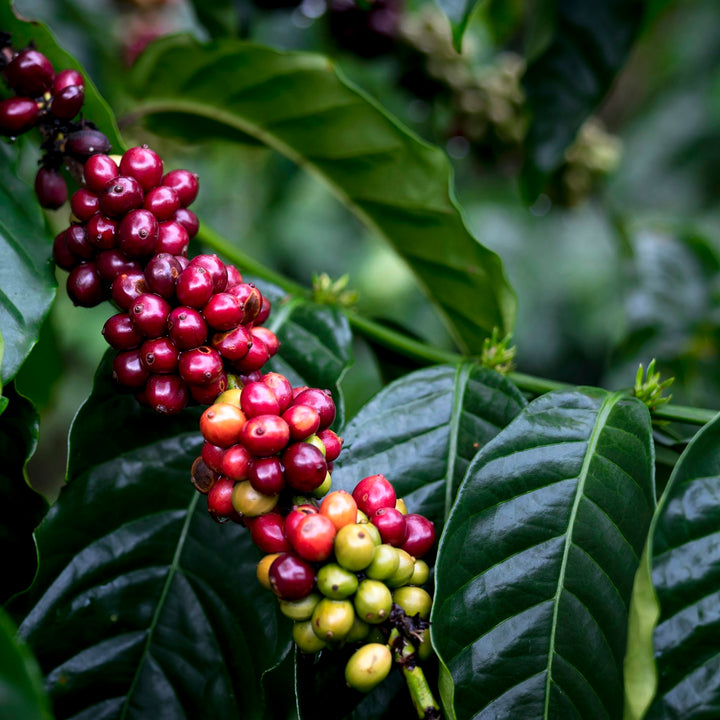
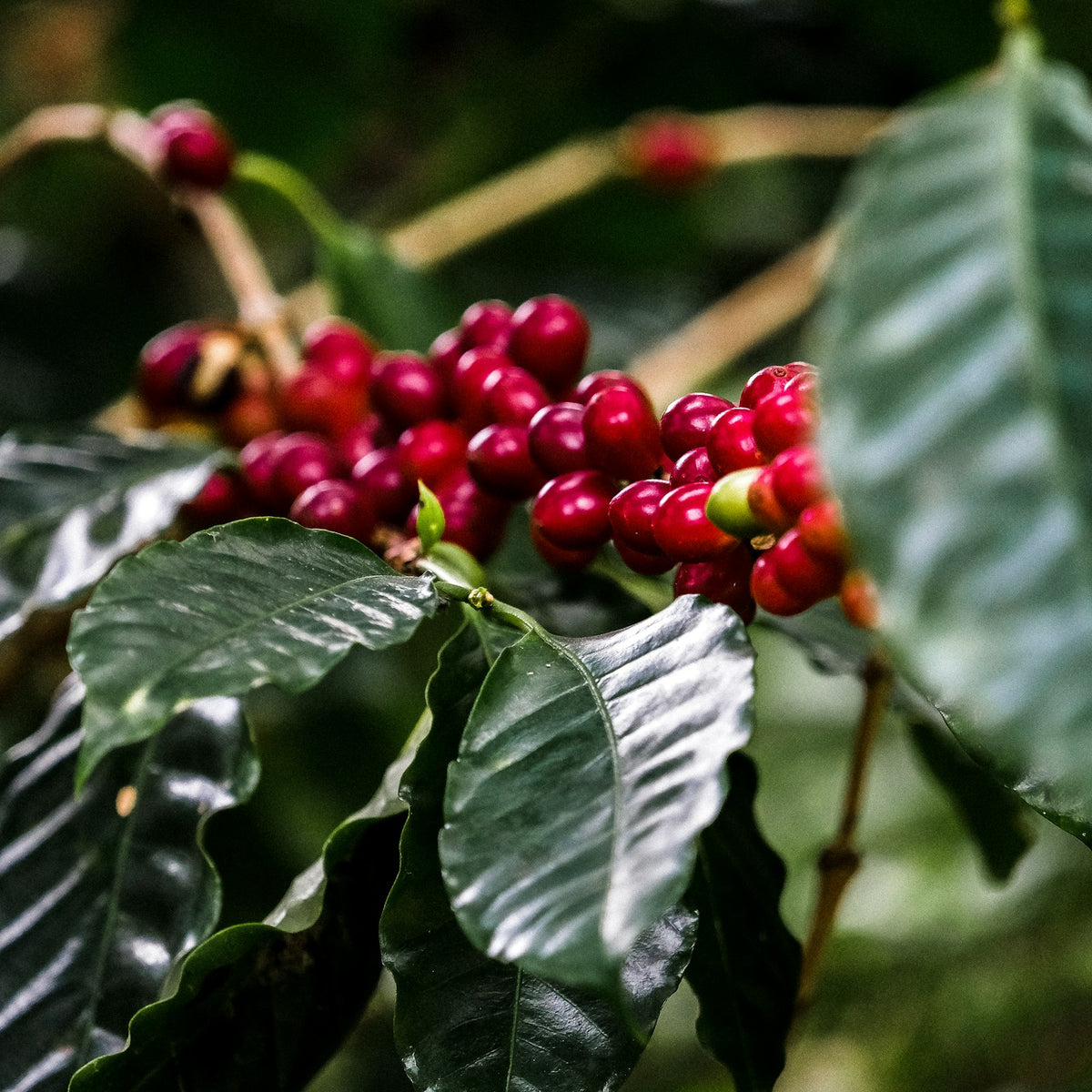
The container in coffee is the genus Coffea, and it holds well over a hundred species. Two of them are farmed at scale. Arabica is one. Canephora, sold as robusta, is the other, and by World Coffee Research's count cited in Sprudge's primer on robusta it now takes slightly more than 40 percent of world production, up from roughly 20 percent when arabica dominated the trade.
Why can't robusta be a variety of arabica?
Because of how the two plants reproduce, and this is the part that settles it rather than merely asserting it.
Pinto-Maglio's review of coffee cytogenetics in the Brazilian Journal of Plant Physiology puts it in one sentence: "Virtually all Coffea species are diploid (2n=2x=22) and self-incompatible, and Coffea arabica L. is the only polyploid species (2n=4x=44) of the genus, and it is self-compatible."
Read that twice, because it carries two facts and both of them matter.
The first is chromosome count. Canephora has two sets of chromosomes, 22 in total. Arabica has four sets, 44 in total. A variety of a species has the same chromosome complement as the species it belongs to, because it is that species, selected down to a narrower population. A plant carrying half the chromosomes is a different organism, and the difference is structural rather than a matter of degree.
The second is the mating system, and it is the one almost never mentioned. Canephora is self-incompatible: a canephora tree cannot fertilize itself, so every seed it sets comes from another tree's pollen and every canephora plot is a genetic shuffle. Arabica is self-compatible. Scalabrin and colleagues, writing in Scientific Reports, describe arabica's mating system as "primarily based on self-fertilization, although pollinator-mediated outcrossing may occasionally occur."
That is why arabica has varieties in the ordinary sense and canephora's are harder to pin down. A self-pollinating plant hands its offspring a near-copy of itself, which is how Bourbon stays Bourbon over generations on a farm with no laboratory attached. A self-incompatible plant cannot do that. The two species do not merely taste different. They make the next generation by different rules.
Is arabica descended from robusta?
Half of it is, and that is the strangest fact in this whole subject.
Arabica is not an ancient species. It is an allopolyploid: a plant formed when two different species hybridized and the offspring kept both full chromosome sets instead of discarding half. Salojärvi and colleagues, in a 2024 Nature Genetics paper on the arabica genome, state it plainly. "C. arabica (2n = 4x = 44 chromosomes) resulted from a natural hybridization event between the ancestors of present-day Coffea canephora (Robusta coffee, subgenome CC) and Coffea eugenioides." They put the founding event somewhere in the range of 610,000 to 350,000 years ago.
So canephora is arabica's parent. Sweet Maria's coffee library, which has been saying this longer than most, calls canephora "a parent species of Arabica" in its robusta entry, and that is exactly right. Arabica's 44 chromosomes are canephora's 22 plus eugenioides' 22, carried together ever since.
The phrase worth noticing in the Nature Genetics sentence is subgenome CC. Arabica did not blend its two parents into an average. It kept them side by side, and geneticists can still read the canephora half and the eugenioides half as separate sets inside a single plant. The robusta in your arabica is not a metaphor. It is half the genome, still legible.
That founding event also left arabica genetically poor. The Nature Genetics team found cultivated arabica "harbors a particularly low genetic diversity," and Scalabrin's group put the consequence in working terms: "The extremely low levels of variation observed in the species, as a consequence of the polyploidization event, make the exploitation of diversity within the species for breeding purposes less interesting than in most crop species." Our Typica record carries the same point from the other direction. The entire species a specialty industry is built on came through one doorway, once.
Where do arabica and robusta hybrids come from, then?
From a rare accident on Timor, and its descendants are probably already in your grinder.
That genetic poverty is the setup. When coffee leaf rust started taking farms apart, breeders looking inside arabica for resistance found very little to work with, because there was very little there. The resistance they needed was in canephora, on the other side of the species line.
Sometime in the twentieth century a spontaneous cross between arabica and canephora appeared in a plantation on Timor. Our own record for Lempira describes the resulting plant as "a natural cross of Coffea arabica and the disease-resistant Coffea canephora," and our IHCAFE-90 record puts it more bluntly still: the Timor Hybrid "contains genetics from both arabica and robusta species." It carried canephora's rust resistance into a plant that still farmed and cupped like an arabica. Nearly every rust-resistant variety planted in Latin America since — the Catimor group, the Sarchimor group, and the F1 hybrids bred from them — traces back to it.
One of them is on our shelf. El Salvador Finca San Luis is Centroamericano H1, an F1 hybrid whose Sarchimor parent descends from that Timor cross. Its cup score, published on the bag like every other coffee we sell, is 86.8.
Kenya reached across the same line for the same reason. Our SL-28 record notes that a coffee berry disease epidemic in 1968 destroyed roughly half of Kenya's coffee production, and that the shock set the direction of Kenyan breeding for the next four decades. Batian, released in 2010 and now planted alongside the SLs, draws on the Timor Hybrid among its parents. Two continents, two diseases, and both answers came from outside Coffea arabica.
An interspecific cross like that is evidence for the species distinction, not against it. Wolves and coyotes hybridize too. What makes the Timor Hybrid remarkable enough to name and track for seventy years is precisely that a fertile arabica-canephora cross is a rare event rather than a Tuesday. Varieties inside a species cross constantly, and nobody writes their pedigrees down.
Does robusta have varieties of its own?
It does, and the structure of the reference catalog is the clearest proof of the whole argument.
World Coffee Research's variety catalog covers two species and lists them separately: arabica varieties from more than fifteen producing countries, and canephora varieties from eight, namely Brazil, Mexico, Uganda, Indonesia, Vietnam, India, Thailand and the Philippines. Robusta does not appear in that catalog as a variety. It appears as a species heading with varieties underneath it, exactly the way arabica does.
If robusta were a variety of arabica, it could not also be a category containing varieties. A thing is not both a shelf and a book on the shelf.
Why does a bag of coffee name a variety and never name the species?
Because on a specialty shelf the species never varies, so there is nothing to print.
This is checkable on our own catalog, and I checked it before writing it down. Every single-origin bag we sell carries a variety field. Kenya Kiambu reads SL-28 and SL-34. Ethiopia Hambela Buku reads Heirloom. El Salvador Finca San Luis reads Centroamericano H1. Organic Peru Decaf carries three. Our one blend, ASCENT, carries none, because a blend has no single answer to give.
What that data model does carry, on every single-origin bag, is origin, region, estate, producer, processing method, drying method, a cup score, tasting notes, and on most of the shelf what we paid per pound for the green coffee. Publishing that last one costs us an argument every so often, and we keep doing it because a customer who can see the input price can see what the roasting is worth. Every one of those fields tells you something that changes from bag to bag.
There is no species field anywhere in that data model, on any bag, and there never has been. Not because we forgot it. Because it would read Coffea arabica five times out of five and tell a customer nothing at all. The variety slot earns its place by changing. A species slot would not.
That is also the honest reason the word goes loose. When every coffee in the room is arabica, variety quietly becomes the word for any difference between two coffees, and then somebody reaches for it to describe a difference that is not a variety difference at all. Robusta is the case where the habit breaks, and it breaks in a way that matters: a label reading "100 percent arabica" is naming the species, which on a specialty shelf is the least informative thing a bag can tell you. It rules out one plant out of two. A bag naming the farm, the process and the variety is answering the question that phrase only gestures at.
Is robusta worse than arabica?
Cheaper, easier to farm, and a genuinely different raw material, which is not the same question as worse.
Canephora carries roughly twice the caffeine. Sweet Maria's puts it at 2 to 4.5 percent against arabica's 1.1 to 1.7 percent, with higher chlorogenic acid alongside it. Sprudge notes it is considerably easier to grow, more tolerant of disease and drought, and productive at altitudes where arabica struggles. Those are the reasons it went from a fifth of world production to more than two-fifths, and they are agronomic reasons rather than culinary ones. What that species does inside a drum is a separate question, and we took it up in should you roast robusta.
The grading system is worth knowing about too. Sweet Maria's is direct about its own practice: "We don't rate Robustas on the cupping scale since traditional cupping doesn't apply on a coffee solely intended as a blend component in espresso." The cupping form the specialty trade scores on was built around arabica, and a canephora lot evaluated on it is being measured with a ruler made for something else.
Here is where I have to hand you off. We publish a cup score on every bag, including the ones that do not flatter us. An 86.8 sits on the same shelf as a 92.3, in public, and it costs us a little every time somebody compares those two numbers instead of drinking either coffee. All five of those scores were taken on arabica, on an arabica form, at our table. I have never put a canephora lot in front of it. So if you want to know how a well-made fine robusta actually cups, I am not your source. I can tell you what the plant is, what its chromosomes do, and why the word on the bag says what it says. Somebody who buys canephora every season should tell you the rest.
Key takeaways
- Robusta is Coffea canephora, a separate species from Coffea arabica, not a variety inside it.
- Arabica carries 44 chromosomes and can pollinate itself; canephora carries 22 and cannot, so the two plants make their next generation by different rules.
- Arabica is itself a hybrid of canephora and Coffea eugenioides, formed once, somewhere between 610,000 and 350,000 years ago, and it still carries both parent genomes side by side.
- Robusta has named varieties of its own in eight producing countries, which is only possible because it is a species rather than a variety.
- A specialty bag names the variety and not the species because on that shelf the species never changes.
From our shelf. Kenya Kiambu is SL-28 and SL-34, both of them Coffea arabica, grown in Kiambu County and cupped at 91.5 on our table. It comes in 250g, 2lb and 5lb, and we grind it to your brewer at no charge. Kenya Kiambu is here, and the rest of what we buy and why is on our origins and sourcing page.