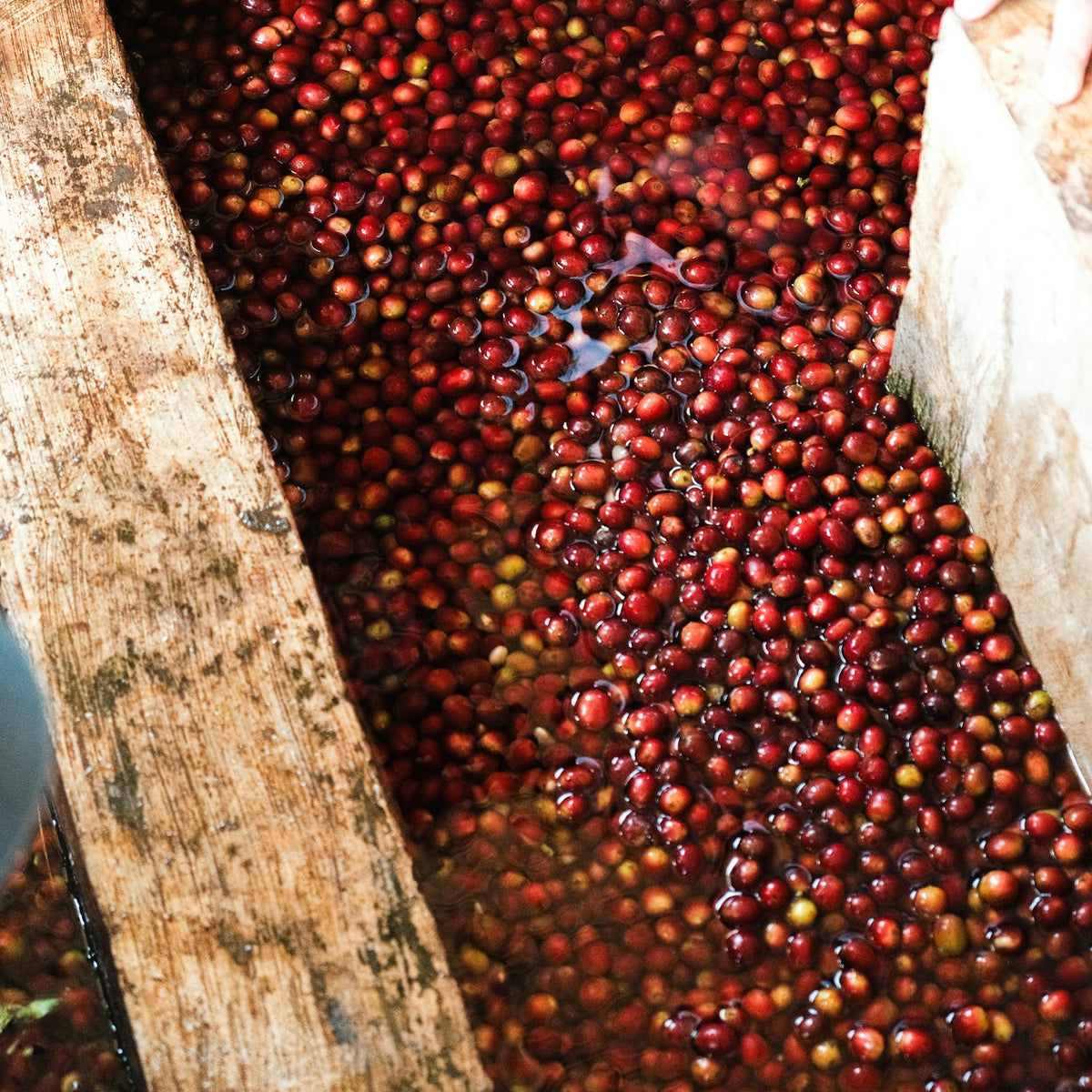
Mucilage is the slippery layer between a coffee cherry's skin and the papery parchment around the seed, and it is about 84 percent water. The rest is structure rather than sweetness: 8.9 percent protein, 4.1 percent sugar, 0.91 percent pectic substances, 0.7 percent ash. Take the water out and the proportions invert. Pectin becomes roughly 30 percent of what is left, cellulose about 8 percent, other non-cellulosic polysaccharides about 18 percent. The coating on a wet coffee seed is a pectin gel holding water, and it is barely sweet at all.
Why is it sticky if it is barely sugar?
Because pectin is a gel former, not a syrup. Those figures come from Patricia Esquivel and Víctor Jiménez's 2012 review in Food Research International, whose alcohol-insoluble residue is dominated by pectic substances. Pectin builds a water-holding network, and a network full of water is slick and hard to rinse. Sweet Maria's, our first import partner, calls the layer "the fruity layer of the coffee cherry, between the outer skin and the parchment layer that surrounds the seed," like pulp on a plum stone.
Perfect Daily Grind's anatomy piece, where most readers meet the word, puts it differently: "Mucilage is the inner layer of the pulp. There's also a layer of pectin underneath." The measurements put the pectin inside that layer rather than beneath it. I follow the measurements, and I name the disagreement rather than smooth it.
Does the fermentation tank eat it?
Mostly not — and I have written the sentence that says otherwise. The shorthand all of us use is that microbes break it down over twelve to seventy-two hours. What was actually measured is smaller and stranger.
Sylvie Avallone and colleagues tracked the cell-wall polysaccharides through a wet ferment and found the alcohol-insoluble residues showing "no apparent degradation," the soluble pectins reduced only slightly, and the insoluble pectic substances partly de-esterified rather than digested. Removal, they concluded, "seems to result from a restricted pectolysis, the mechanism of which remains to be elucidated." A year later the same group looked for the enzymes. The pectate lyase produced by the tank's most common bacteria peaks at pH 8.5, and a fermenting tank runs acid, from about 5.3 down to 3.5. Their reading: decomposition "seems to be correlated to acidification and not to enzymatic pectolysis." Sterile controls came apart on their own in two to three days.
Esquivel and Jiménez describe the layer as hydrolyzed by enzymes from the coffee tissue and from microorganisms, which is the tidier story. Avallone's group looked for that activity at a real tank's pH and did not find enough of it. So the honest version is that fermentation loosens a gel and the wash is what takes it off. Mills that skip the tank agree. Writing for the Specialty Coffee Association, Carlos Brando describes mechanical removal as "friction between parchment beans themselves and the parts of the machines," on half to one cubic meter of water per ton of wet parchment, 70 to 80 percent less than the older approach.
What happens when a producer leaves it on?
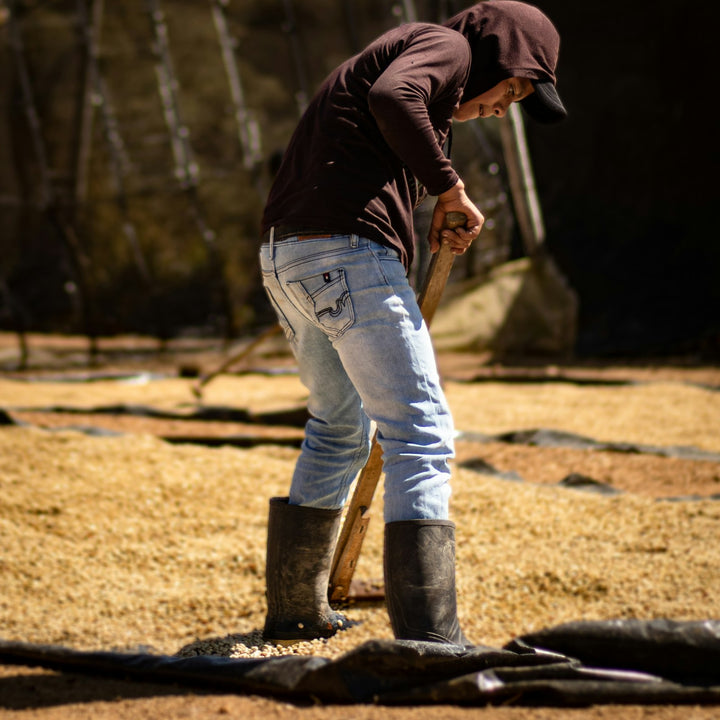
The drying bed does the work the tank would have done, slower and in open air. That is honey processing, where a chosen fraction of the fruit stays on the seed, and a natural, where none of it comes off. We publish long records for thirteen processing methods, and the honey grades in ours run the way the trade describes them: white and yellow keep the least, red keeps most, black keeps essentially all and dries slowest. What is being dialed is how much of that gel the microbes and the sun get to work on, and what those microbes do during a long dry is better documented than what a tank does in a day.
I should be plain about where we are the wrong people to ask: we buy finished lots. We have never run a wet mill, set a rotor gap, or calibrated a honey grade. If you are on your own patio deciding between a red and a black, ask your mill, not us.
Does any of this change the coffee you buy?
It changes what a processing word on a bag is telling you. Washed does not mean clean in any moral sense; it means the gel was loosened and rinsed away before drying, so the seed dried alone. Most of our single origins right now are naturals, the opposite decision. The one washed coffee on our shelf is Kenyan, where the regional system is built on depulping, fermenting and washing to a standard.
Publishing thirteen method records for a shelf that has sold a handful costs us something, and it is not writing time — we keep an encyclopedia for coffees we do not stock, which is how one loose sentence about a tank gets published thirteen times instead of once. The last skin on the seed is the only part of the fruit that reaches a roaster. Everything else is settled at a mill in another country, by somebody making a decision about a net of pectin holding water.
Kenya Kiambu is the one washed coffee on our shelf: depulped, fermented, washed clean, dried on raised beds, and it cups 91.5. We roast to order every Wednesday in Pensacola and grind it to your brewer at no charge. Kenya Kiambu is here.