Coffee production in Central America and Mexico is expected to fall 9.3% in the 2026/27 crop year to below 18 million 60-kilogram bags, according to a Sucafina report released on 4 November and reported by Marcelo Teixeira of Reuters, in a copy published by Notícias Agrícolas. The region produced 19.68 million bags of arabica and robusta in 2025/26, above expectations, the same report said.
That is a forecast, made a month into a crop that began in October. Sucafina expects the sharpest falls in Honduras and Mexico, with Guatemala close behind, Reuters reported. The report as published gave no figure for each country.
What is Sucafina blaming?
The trading house pointed to weather anomalies in the first half of 2026 and to the low year of arabica's two-year cycle, in which trees that carried a heavy crop bear less the following season, according to the Reuters account. Oscar Fernando Hurtado Ramirez, Sucafina's global director of production research, said pest and disease control in the last quarter of the year would be critical. He also said the quality of the crop was uncertain, with drought and heat hurting fruit development and raising damage from the coffee berry borer, a beetle that bores into the cherry.
The gap between the two crops is about 1.7 million bags by our arithmetic, if the new figure lands near 18 million. That is about a seventh of what Colombia exported in its last coffee year, using the 11.78 million bags the FNC reported in October, as we covered then.
What is Costa Rica reporting?
Costa Rica's estimates have also come down. Growers now expect a harvest 10% to 15% smaller than first estimated, The Tico Times reported on 3 November, citing Icafé. Miguel Barquero, Icafé's deputy director, said estimates had come down across the growing regions and that the quality and weight of green coffee for export had been affected, the paper reported. Irregular rain delayed fertilization by about 30 days, according to the same article.
The Tico Times also cited the Central Bank of Costa Rica's October Monetary Policy Report, which projects farm-sector growth of 0.7% for 2026 and a contraction of 0.5% for 2027. Those are figures for all of agriculture, not coffee alone. Costa Rican growers had already reported losses from a strong colón, as we reported in October.
How does this compare with October's forecasts?
On 8 October, Reuters reported that initial 2026/27 forecasts put Honduras down 7% and Guatemala down 10%, and that both could be cut, after a drought in the Dry Corridor that peaked in July and August. Our report at the time covered that drought and the arabica premiums that followed it. Honduras' own institute, Ihcafé, forecast 7.0 million 46-kilogram sacks for 2026-27 when the last coffee year closed, as we reported on 3 October.
In its most recent discussion, issued 8 October, the US Climate Prediction Center said it was keeping its El Niño Advisory and put the chance of a strong to very strong event lasting through January to March 2027 above 83%. Its next update is scheduled for 12 November.
- Central America and Mexico, 2025/26 output: 19.68 million bags, as reported by Reuters from Sucafina, 4 November 2026
- Central America and Mexico, 2026/27 forecast: below 18 million bags, down 9.3%, as reported by Reuters from Sucafina, 4 November 2026
- Costa Rica, 2026-27 harvest: 10% to 15% below the first estimate, as reported by The Tico Times from Icafé, 3 November 2026
- El Niño, January to March 2027: above 83% chance of a strong to very strong event, as reported by the Climate Prediction Center, 8 October 2026
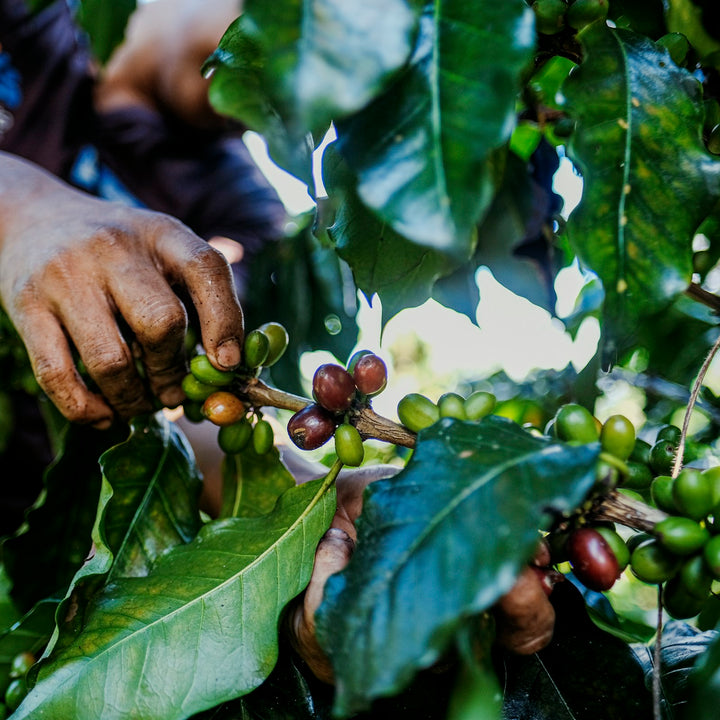
Photograph: Luba Glazunova, Unsplash. A worker picking coffee cherries at a small plantation in Taiwan; not taken in Central America.