Colombia exported 8.45 million 60-kg bags of coffee from January to September 2026, down 13.8% from 9.80 million in the same months of 2025, according to figures from Asoexport, the coffee exporters' association, reported by La República on 19 October 2026. The association's executive president, Gustavo Gómez Montero, said a stronger peso and higher costs were cutting into what exporters earn.
The shortfall is 1.35 million bags, Portafolio reported the same day, or about 81,000 metric tons of green coffee (our arithmetic at 60 kg a bag). La República reported that the nine-month total was the lowest since 2023, when 7.49 million bags were shipped in the same period.
How does the exchange rate cut exporters' income?
Coffee is sold abroad in dollars, so a stronger peso means fewer pesos for every dollar of coffee sold. Gómez put a number on it, as reported by Portafolio on 19 October 2026. Colombia exported 13.14 million bags in 2025, worth 20.58 trillion pesos at that year's average rate of 4,052.71 pesos to the dollar. At the 2026 average he cited, 3,503.06 pesos, the same exports would have brought in about 17.79 trillion pesos, roughly 2.8 trillion less.
That 2.8 trillion pesos is about US$800 million at the 2026 average rate Gómez cited (our arithmetic). It is a calculation on last year's sales at this year's exchange rate, not a measured loss.
"La revaluación del peso genera una caída en los ingresos," Gómez said, as quoted by Portafolio and by Infobae on 19 October 2026. In English: the revaluation of the peso causes a fall in income. Both Portafolio and La República also quoted him saying the contraction directly reduces the sector's profit margins.
Costs are rising at the same time. La República reported that Gómez also pointed to labor reforms and the 2026 minimum wage increase, which the paper put at 23.7%.
Did exports pick up in September?
September alone went the other way. Exports that month were 1.17 million bags, up 9% from September 2025, according to the Asoexport figures as reported by all three outlets on 19 October 2026.
For the coffee year that ran from October 2025 to September 2026, Asoexport counted 11.68 million bags exported, down 11%, La República reported. The National Federation of Coffee Growers (FNC) published its own count for the same coffee year on 9 October 2026: 11.78 million bags, down 12%, alongside production of 12.65 million bags, down 15%, as we reported in our story on Colombia's coffee-year close. Infobae printed both figures on 19 October without explaining the difference, and neither organization has been reported reconciling them.
Is Colombia the only origin facing a strong currency?
Costa Rica's coffee sector reported a similar squeeze from a strong colón earlier this month. Fernando Naranjo, board president of the Costa Rican Coffee Institute, told the Tico Times on 7 October 2026 that the exchange rate had reduced what growers receive per fanega, as covered in our report on Costa Rica's coffee farms. Background on the Colombian origin itself is in our explainer on Colombian coffee.
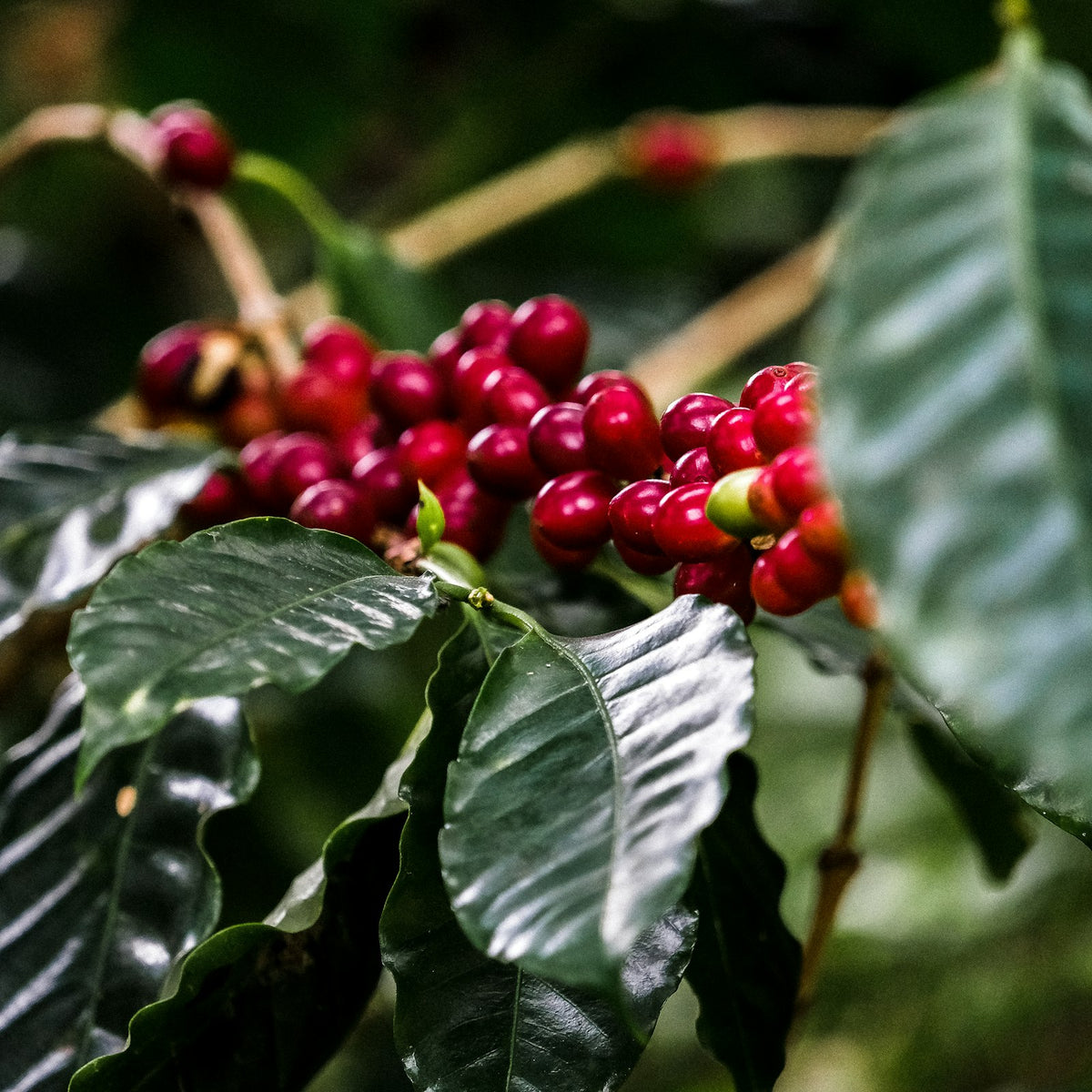
Photograph: Cédrina Laberge, Unsplash. Coffee cherries on a coffee plant, tagged by the photographer with Colombia, not taken at any farm named in this story.
This report is built on reporting by La República, Portafolio and Infobae of Asoexport's figures, and on the Federation of Coffee Growers' published balance. Quotations are as published in those reports; the English rendering is our translation.