No study has yet shown that co-fermented coffee reliably tastes better than coffee fermented the ordinary way, and the one experiment actually built to test that question found a difference too small to trust from a single farm and three tasters. That is not the same as saying co-fermentation does nothing. It is saying the industry argument over it has gotten ahead of the evidence in both directions, toward the producers claiming a breakthrough and toward the competition judges calling it fraud.
Co-fermentation means fermenting coffee cherries or parchment alongside something that is not coffee: fruit, fruit pulp from an earlier batch, hops, spices, or a dosed yeast strain, sealed into the same tank where the coffee's own sugars are already breaking down. It is a few years old as a named practice and it is already controversial enough that a national coffee association disqualified competition entries over it in 2024. What almost nobody in that argument has cited is the one controlled study that actually ran the comparison with a lab behind it rather than a cupping table alone.
What Is Co-Fermentation, And How Is It Different From Inoculation?
Royal Coffee's green buyer Amanda Amato and trader-writer Chris Kornman laid out the vocabulary clearly in a piece Royal Coffee republished from Roast Magazine, and it is worth ceding to directly rather than re-deriving: co-fermentation adds a non-coffee ingredient to the tank, while inoculation adds a known microbe, usually a chosen yeast strain, to steer a fermentation that would otherwise run on whatever is already on the cherry. The two get lumped together constantly and they are not the same move. Fruit is the most common co-ferment additive, but Kornman's piece also names hops, spices, organic acids, and a practice called "mossto," pressed pulp or juice saved from a previous batch and added to a new one as a kind of starter. Colombian producer Edwin Noreña, quoted in the piece, calls a technique he uses on a lot he names Black Ginger Ale Gesha a combination of "black honey double carbonic maceration mossto and galaxy hop," and describes mossto itself as a catalyst meant to "accelerate, control, and enhance fermentation" rather than a flavor additive in its own right.
That distinction matters because it is the one the loudest critics tend to erase. An inoculated ferment, the kind a growing number of washed and honey lots now use, adds a microbe and nothing else; a co-ferment adds a second substrate for that microbe to work on. Both are interventions on a process that was never actually hands-off to begin with. We have written before about what is biologically happening inside an ordinary honey lot and a sealed carbonic-maceration tank, and in both cases a population of bacteria and then yeast was already doing real metabolic work before anyone called it experimental. Co-fermentation is one further step along a line the industry had already been walking.
Why Did Panama's Coffee Association Call It Cheating?
The sharpest public move against the practice came on June 28, 2024, when the Specialty Coffee Association of Panama disqualified four entries from that year's Best of Panama competition. Daily Coffee News reported that SCAP president J. Hunter Tedman signed a statement accusing the producers of submitting coffees "altered from their natural DNA expression," done, the statement said, "likely with the intent to score higher and win by using foreign additives." SCAP called for other green coffee competitions worldwide to adopt the same hard line, and asked that altered or infused coffees be categorized separately rather than judged alongside coffee that had only ever touched water and its own fruit.
The disqualification is a real and defensible competition-integrity call: if a rulebook says judge the coffee as it naturally grew, and a lot was run through a tank with pineapple or hops in it, that lot broke the rule it was entered under. But the specific language is worth stopping on, because fermenting a cherry next to a piece of fruit does not touch the plant's genetics in any sense a biologist would recognize. Nothing about soaking a seed in a tank with added sugar or added microbes rewrites a single base pair of its DNA. What actually changes is the chemistry building up around the seed while it sits in that tank, the same category of change that happens, more slowly and more mildly, in an ordinary thirty-hour washed ferment. Calling that "altered DNA expression" dresses up a dispute about disclosure and competition rules as if it were a dispute about genetic purity, and nobody covering the story seems to have called that framing out directly.
Why Are The Stakes At Best Of Panama High Enough To Fight Over?
It helps to know what a winning lot at that auction is actually worth before judging how hard anyone would push for an edge. Four years before the disqualification, in September 2020, a washed Gesha from Finca Sophia, co-owned by Willem Boot and Catherine Cadloni of Boot Coffee and by Helen Russell and Brooke McDonnell of Equator Coffees, sold at the same Best of Panama auction for $1,300.50 a pound, a figure Daily Coffee News reported as shattering the previous record of $1,029 set the year before, which itself had broken $803 in 2018 and $601 in 2017. That same 2020 auction sold fifty-one 100-pound lots with not one going for less than $29.50 a pound, thirty-six clearing $50, and four clearing $350, against an ICE "C" arabica price sitting just over $1.14 a pound at the time, roughly a thousandth of what the top lot brought. Most of the winning bids came from buyers in China, Japan, and Taiwan.
None of that is a claim that the record Gesha lot was co-fermented; it was not, and I am not implying otherwise. What it shows is the scale of the prize a cupping-table ranking at this single auction can produce, in a market where a few points on a score sheet separate a lot worth tens of dollars a pound from one worth hundreds. Against stakes like that, a producer who believes a tank additive buys even a half-point of separation has a real financial reason to try it, and a competition association that believes the same technique threatens the auction's whole premise, that buyers are paying for a specific farm and a specific natural process, has an equally real reason to draw a hard line. Neither side's incentive makes either side's factual claim correct on its own, which is exactly why the actual lab measurements above matter more than either argument does.
What Does The One Controlled Study Actually Show?
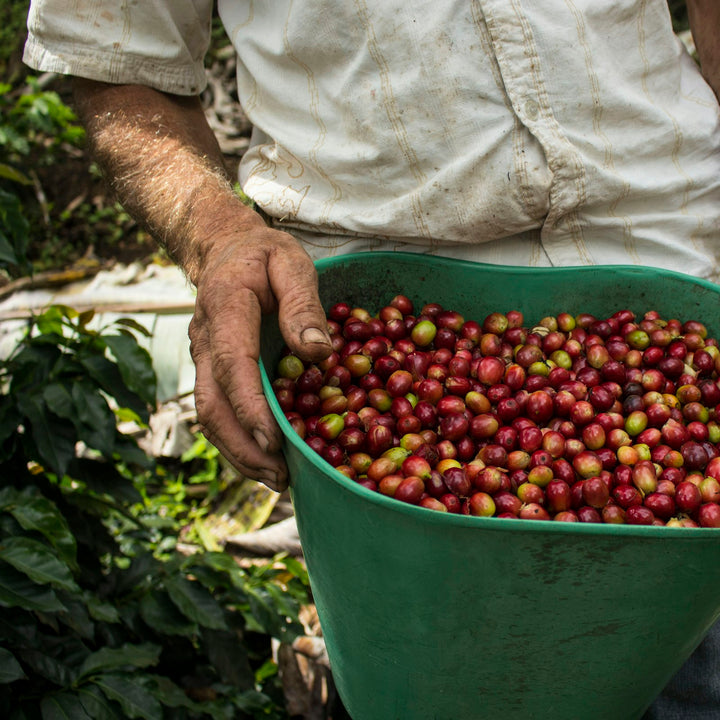
Away from the competition floor, a team working with Coffea arabica var. Castillo on a farm in Risaralda, Colombia, ran the comparison a competition disqualification cannot: the same cherry, split into two fermentation tanks, one left alone and one deliberately co-fermented, with everything else measured rather than argued. The preprint, posted to bioRxiv, split 155 kilograms of fresh cherry two ways. One batch fermented spontaneously in 200-liter tanks with 55 liters of added water for 100 hours, nothing else introduced. The other, the inoculated batch, fermented in 30 liters of water plus 10 liters of a starter culture and 35 kilograms of crushed pineapple, also for 100 hours. The starter culture itself was "a defined cocktail of commercially available yeast strains," left unnamed in the paper under a confidentiality agreement with the producer, which is its own small tell about how guarded this practice still is even among the people studying it.
Three Q Graders cupped both batches using standard SCA protocol. The paper reports that "uniformity and cleanness differed significantly" and that the inoculated, pineapple-fermented batch "was perceived as sweeter and less acidic, with a cleaner cup." The microbiology behind that difference is specific: spontaneous fermentation carried greater fungal diversity, while the inoculated batch showed no significant difference in bacterial diversity, and in both tanks Lactobacillus and Leuconostoc dominated the bacterial side while a yeast called Kazachstania humilis ran strong on the fungal side. Metabolomics found 59 compounds that moved between the green beans from each treatment and 77 that moved in the roasted beans, with the statistical models behind those numbers reporting a coefficient of determination above 0.9.
Read as a single data point, that is a real, measured difference, and the authors conclude plainly that "the inoculated fermentation resulted in a better cup quality for the brewed coffee." Read as evidence for an industry-wide claim, it is thin. One farm. One starter culture, with the exact strains withheld. One fermentation run per treatment, not a repeated trial. Three cuppers, with no report of a second cupping session to check whether they agreed with themselves a week later. The paper's own authors note that their 100-hour sampling window limits how directly they can tie a specific microbe to a specific flavor compound, and nothing in the text supports treating "reliably improves the cup" as settled. It supports "did, once, on this farm, with these undisclosed yeasts."
Does Fermentation Leave A Chemical Signature Flavoring Doesn't?
One real way to answer the "is this just flavored coffee in a trench coat" question is chemical rather than rhetorical, and a 2023 paper gets at it from a different angle. Researchers at the University of Melbourne, led by H. Wu, compared spontaneously fermented and unfermented arabica from two Australian farms, publishing their results in Food Research International that December. Using gas chromatography-mass spectrometry, they found that roasted fermented coffee could be told apart from roasted unfermented coffee by three specific pyrazine compounds: methylpyrazine, 2-ethyl-5-methylpyrazine, and 2-ethyl-6-methylpyrazine, each showing up at reliably different levels depending on whether the green coffee had fermented first. The fermented batches also scored higher on dark chocolate, roasted, and butter flavor notes, and on crema height and color once pulled as espresso.
That is a genuine fingerprint, not a marketing claim: fermentation measurably rearranges a coffee's own chemistry before it ever meets a roaster, in a way an external flavoring sprayed or soaked onto a finished bean would not. It does not settle whether co-fermentation specifically, with a second ingredient added to the tank, produces a fingerprint a trained panel or a lab could tell apart from an ordinary ferment. That comparison has not been run yet, which is a real gap and a more useful place to put research money than another disqualification statement.

Does Anyone Have To Tell You A Coffee Was Co-Fermented?
This is the part of Kornman's reporting that got less attention than the DNA line, and it is the sharper question. Under current United States rules, a co-fermented green coffee is treated exactly like any other green coffee. There is no FDA labeling category that distinguishes a lot fermented alone from one fermented with pineapple, hops, or a saved batch of mossto added to the tank. Kornman's piece raises the New York Green Coffee Association's long-standing contract language as the closest thing the trade has to a rulebook, and even that body has not settled whether an additive at the fermentation stage counts as an "ingredient" the way a blended spice or flavoring oil would once a bag is sealed. Tim Heinze, quoted in the same piece, raises the practical half of the problem directly: should a producer be required to disclose a technique that took real trial and error to develop, in a market where competitors are reading every public description looking for an edge? Kornman's own answer leans toward skepticism of the double standard baked into that question: "Is it possible that our calls for transparency from producers are bordering on a double standard?" he asks, pointing out that roasters routinely decline to publish the exact ratios inside a blend, and nobody calls that fraud.
That reframes the Panama disqualification in a way the "altered DNA" language obscured. A competition that wants coffee judged on where and how it grew, untouched by anything added at the tank, has every right to write that rule and enforce it. What it does not have is a chemistry claim to stand on when it reaches for the word "altered" in a genetic sense. The honest version of SCAP's objection is a rule about disclosure and category, not a rule about purity, and a trade press that keeps repeating the DNA framing without pressing on it is letting a vivid phrase do the work a clearer sentence should be doing instead.
Can You Buy A Co-Fermented Coffee From Us?
Not today, and I want to be honest about what that means for everything above: this is what I read and reported, not what I cupped against a lot we chose. We have never bought a co-fermented or inoculated lot. That is not a verdict on the practice. It is a plain fact about our current shelf, and I would rather say so than let the research above read as a tasting note it is not.
If you want to taste what an ordinary, unaugmented fermentation does to a cup before you go looking for an experimental one, our washed Kenya Kiambu, cupping 91.5, is the honest baseline: depulped, fermented on nothing but its own sugars and whatever lived on the cherry already, then fully washed and dried. Everything the Colombian study measured as a change from "spontaneous" started from a process a lot like this one.
Inheritance Coffee, Pensacola. Read more on how fermentation already shapes an ordinary lot in our pieces on honey processing and carbonic maceration, or read the mechanism itself on our anaerobic processing page.