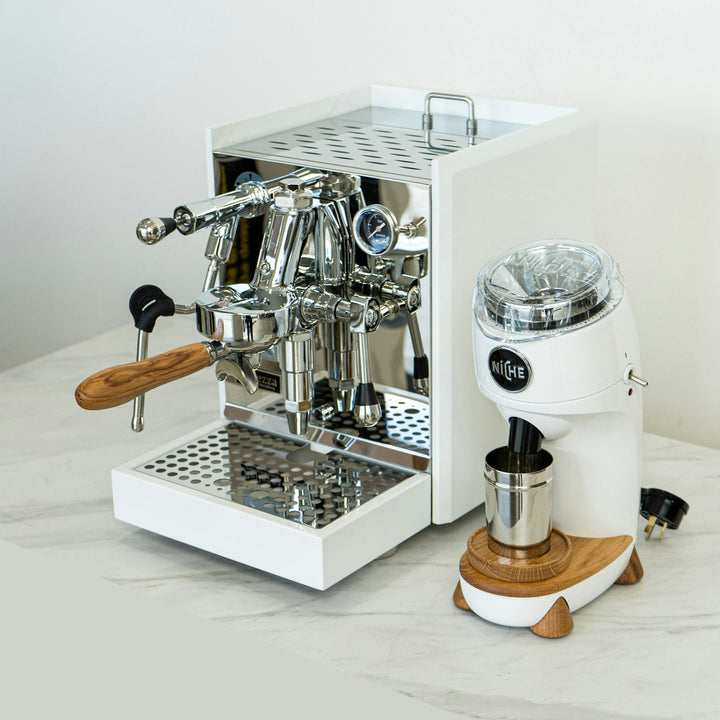
I was out of town when one of my baristas took the coffee cart to an event without the portafilter. An espresso machine without a portafilter is a boiler with a light on it. There is nothing to grind into, nothing to tamp, nothing to lock in, and no way to improvise around it in front of a line. I found out when I answered my phone to a very angry customer.
Nothing about that was a skill problem. What went missing was a piece of hardware, and the reason it went missing is that nobody, me included, had written down what goes in the van. So when somebody asks me how to train a new barista, I start somewhere that does not feel like training at all. Write the job down first, then teach it in this order: the room, then the machine, then one drink, then the rush. And the thing that decides when a new person can work a shift without you standing there is not how many weeks they have been on the payroll. It is how much of your bar exists somewhere other than inside their head.
What do you teach a new barista first?
The room, before anything that plugs in. Where the beans live and which bag is open. Where the backup milk is. Which sink is which, where the towels are, what gets locked, what the opening order is and who has the keys. None of that is coffee and all of it is the difference between a new person who looks calm on their second shift and one who is opening cupboards while somebody waits.
Then the machine, cold. Grinder on, hopper, dose, where the tamper lives, how the group head comes apart, what the backflush routine is, and what the machine sounds like when it is happy. I would rather somebody spend their first hour taking a group head apart and putting it back together than pulling twelve shots they have no way to evaluate yet.
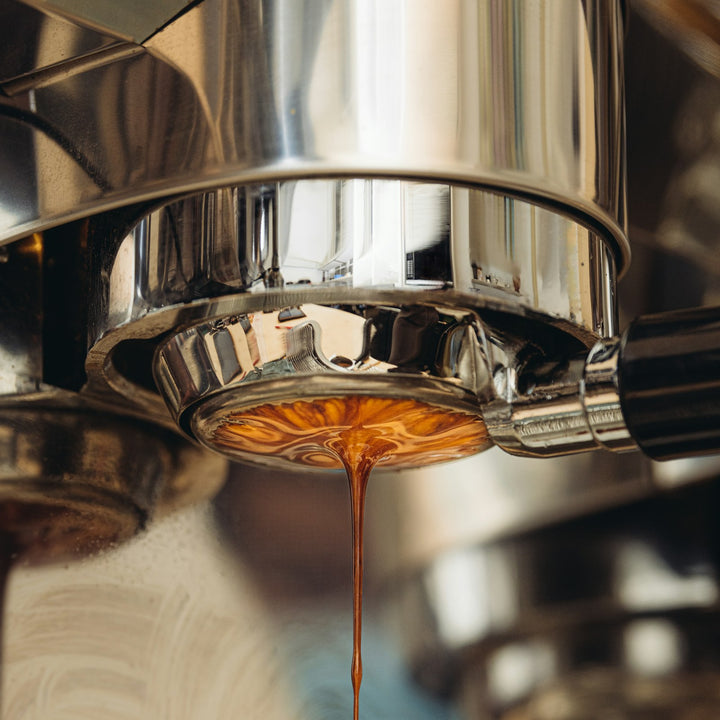
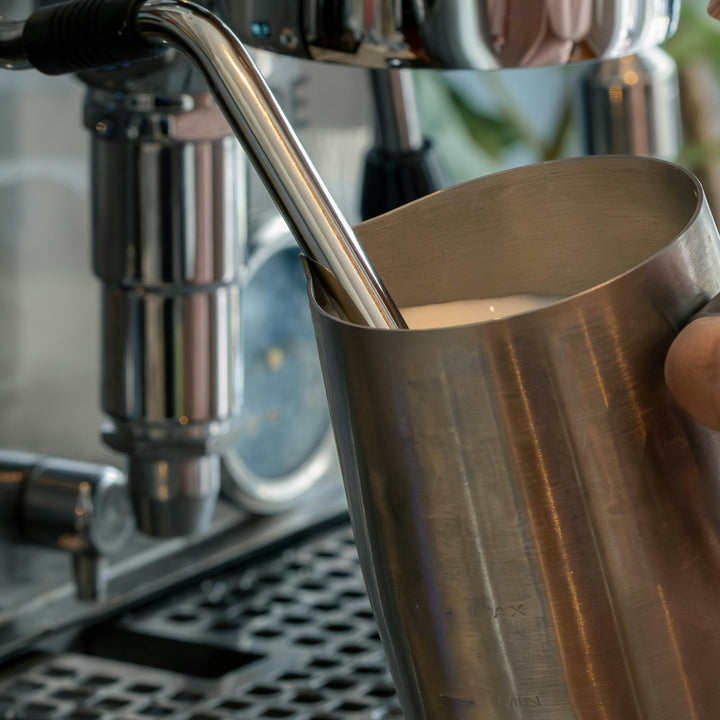
Then one drink. Not the menu. One. A double espresso, weighed in and weighed out, over and over, until they can tell me what a fast one tastes like and what a slow one tastes like without looking at the timer. Espresso first is not a tradition, it is arithmetic: nearly every other drink on a cafe menu is that shot plus milk, so a wobbly shot is a wobbly menu. Once the shot is steady, milk is the next skill and it has its own cue, which is the pitcher getting too hot to hold.
Then the rush, and this is the stage worth protecting time for. Making a good drink and making eleven good drinks while somebody changes their order halfway through is not the same skill, and it is not trained the same way. It is trained by standing next to somebody during an actual rush. The order things sit in behind the bar does more for a new person's speed in their first month than coaching does, because a bar laid out badly makes a competent person look slow.
How long does it take before a new barista can work alone?
The published range is enormous, and the range is the useful part. Perfect Daily Grind's 2019 piece on this question is the best thing written on it, and it quotes cafe owners who treat a new barista as an apprentice for the first three months, as a junior barista from three months to a year, and as fully proficient only after that. One owner it quotes does not leave a barista unsupervised on a shift until they have had a year of training. The same piece notes that a foundation-level SCA course can be done in a minimum of eight hours.
Against that, Deputy publishes a four-week template: shadow in week one, supervised drinks in weeks two and three, independent stations in week four. Both were written by people who have run bars. One says four weeks, one says a year, and that is a thirteenfold spread on the only question the person doing the hiring actually cares about.
Put those two numbers in shifts and the gap stops being abstract. At five shifts a week, four weeks is about twenty shifts of supervision. A year is closer to two hundred and fifty. Nobody is paying a trainer to stand next to somebody for two hundred and fifty shifts, so in practice the owner working from the longer number does not supervise for a year — they leave the person alone at some point and simply never decide when.
Both timelines are right, and they are answering for different bars. A year is the honest number when the standard lives in somebody's head. Four weeks is the honest number when it lives on a card. The variable is not the person you hired and it is not their aptitude — it is how much of the job was written down, measured and made checkable before they arrived. That is the half of this you control completely, and it is cheaper than the half you do not.
We publish a narrower version of the same answer on the church side, at our consulting page: a volunteer can be competent in one shift if the routine is written down and the menu is short enough, and charging money changes it, because people who pay expect speed. That is a free coffee table with three drinks on it. A cafe bar with a full espresso menu and a queue behind it is a longer ramp. The mechanism underneath both is the same one, which is why the fix is the same in a church lobby and in a shop.
What has to be written down before you leave somebody on the bar?
Six things. They take an afternoon to write once and then they are written.
- The recipes. Dose in grams, yield in grams, time in seconds, for espresso and for batch brew. Not "two shots." The numbers.
- The dial-in routine. What gets checked at open, in what order, and what to do when the shot runs fast.
- The build for every drink on the menu. Ounces of milk, number of shots, order of assembly, which cup.
- Open and close. A list, in sequence, weighted toward the things that are easy to forget at the end of a shift rather than the start of one.
- The cleaning calendar. Daily, weekly and monthly, with one name against each.
- Who to call. For the machine, for the milk order, and for a customer nobody on shift can make happy.
That list is the reason we argue for writing the recipe for the person who has been on the bar three weeks rather than for the person who trained them. A card somebody can act on unaided is the one that survives a staffing change, and every hour spent writing it is an hour not spent standing behind a new person explaining the same thing again.
My own version of that list is a cart checklist, and it exists because of the portafilter. I read it twice before I leave for an event now. It is not a sophisticated document. It is the most valuable page of paper in the business, and I wrote it after the mistake rather than before it, which is the part I would change if I could.
How do you know when somebody is ready?
You watch them do the job on a real shift and you check four specific things, rather than forming an impression and hoping. This is the step that turns a training plan into a decision, and it is the one I care most about getting right, because it is the moment somebody's bad shift stops being your fault and starts being theirs.
- Can they dial in from cold, alone? Not adjust a grinder somebody else already set. Walk in, grind, weigh, taste, correct, and land on a shot they can defend out loud.
- Do they catch their own bad drink? Anybody can pour a bad latte. The question is whether it goes in the sink without being asked. Somebody who serves a drink they know is wrong is not ready, however good their good ones are.
- Can they hold quality through a rush? Ten minutes of pressure tells you more than a week of quiet practice, because speed is where a half-learned routine falls apart.
- Do they know what they are not allowed to decide? A new person needs to know which calls are theirs and which need a phone call. Confidence in the wrong place costs more than hesitation does.
When all four are true on a real shift, they are ready, and the calendar does not get a vote. When one of them is not true, name the one and train it, rather than adding another week and hoping the week does the work.
What does a four-hour barista training session cover?
We run a four-hour barista training session for up to six people at a time, and it covers dialing in espresso, building espresso drinks, steaming milk, bar workflow and cleaning practices. That is an honest afternoon and it is genuinely the fastest way to get a team from nothing to a standard, because six people learning the same routine at the same time leave holding the same reference.
Here is what four hours cannot be. It cannot be the ramp. Nobody becomes able to run a bar alone in an afternoon, and I would not want the session sold as though they could, because the owner who believes it schedules the new hire onto a solo Saturday and finds out the hard way. The session teaches the standard. The shifts afterward are where it sets, and the written version is what holds it in place between them. If your team has already been trained and the drinks still move, the problem is downstream of training and another session will not find it.
Whether training comes with a wholesale account is a conversation rather than a policy, and our cafe wholesale page says so plainly: ask during the first conversation rather than assuming it either way.
Does training fix an inconsistent bar?
Mostly not, and this is where I would talk somebody out of booking us. We have published the argument against ourselves already: coffee shop consistency is a measurement problem before it is a training problem. Water, burr wear, coffee age and a lot change behind a familiar name are all invisible to training, because not one of them is something a barista does. A well-trained team on a drifting supply produces a drifting drink, and the team takes the blame for it.
So if your drinks are inconsistent and your staff have already been trained, spend the money on a scale, a water test and a supplier who tells you when the lot changes, before you spend it on another session.
There is a second place we are the wrong answer, and it is worth saying out loud. We are a roastery, not a staffing company. If what is actually breaking is hiring, scheduling and turnover, with people leaving faster than anybody can be trained, another training session does not touch it. That is a management problem and it needs somebody who works on management problems. What we can do is make the thing a new person has to learn small, written and consistent, so that turnover costs you days instead of months.
The fastest barista you will ever train is the one who walks into a bar that already knows what it is doing.
Questions we get about training a new barista
Should a new barista shadow someone before working alone?
Yes, and the shadow shift is worth more than the practice session that precedes it. Working beside somebody on a live bar teaches sequence and pace, which are the two things a quiet practice hour cannot teach. Keep it short and deliberate: one shift watching, one shift doing with somebody beside them, then a solo shift on a slow day rather than a busy one.
What should be on a barista training checklist?
Recipes with weights and times, the dial-in routine in order, the build for every drink, open and close sequences, the cleaning calendar with an owner for each item, and who to call when something breaks. Write it for somebody three weeks in, not for the person who trained them, and keep it where the bar is rather than in a binder in the office.
How often should you retrain a barista?
Retrain on events rather than on a calendar. A new coffee, a new machine, a new drink, a new season, or a drift somebody has noticed in the cup are all reasons. Time passing on its own is not one. A short reset tied to a real change lands better than a long refresher scheduled because a quarter ended.
Can somebody with no coffee experience become a good barista?
Routinely, and inexperience is easier to work with than confident bad habits. What matters is whether they will follow a written standard while they are still learning why it exists. Somebody careful with no experience gets to a reliable bar faster than somebody experienced who already knows a different way of doing it.
Training your team, or building the standard first? Our barista training session runs four hours for up to six people, and it covers espresso, milk, workflow and cleaning in one sitting. If what you actually need is the written version of your bar — recipes, routines and who owns what — that is the consulting side of what we do, and it is usually the cheaper place to start. Either way, ask about it on the first call: how the wholesale relationship works.