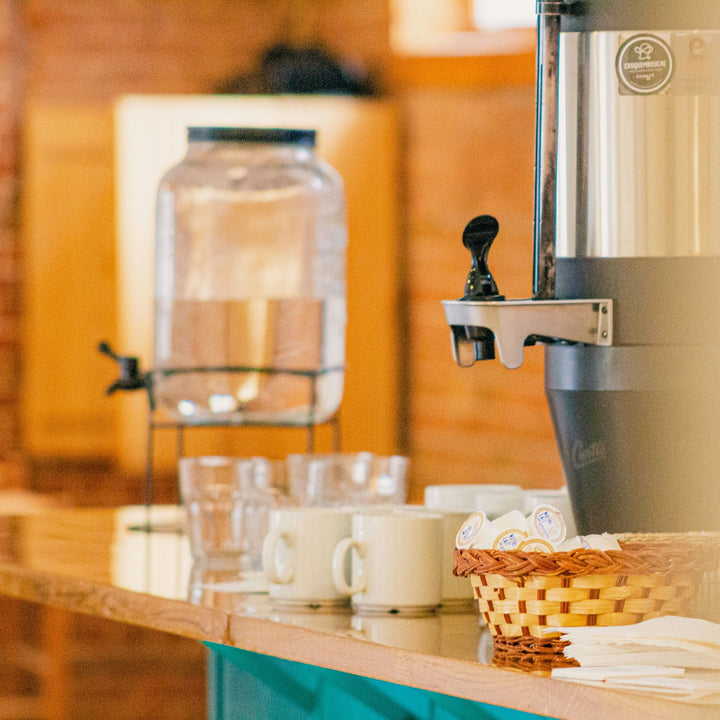
Budget two people on the coffee bar most Sundays and a third who can be called on, not one volunteer who always says yes. We consult on church coffee programs regularly, and the ones still running smoothly a year in are almost never the ones with the most dedicated volunteer. They are the ones where the job was never allowed to belong to just one person in the first place.
How Many People Does a Normal Sunday Actually Need?
Two is the floor for almost any church running an urn or airpot setup, even a small one. One person brews, sets out cups and watches the table; the second handles the inevitable interruption, a spill, a guest with a question, someone who needs decaf and the carafe is empty. A single volunteer can do the job on an easy Sunday and will be stuck on a hard one, and hard Sundays are the ones a guest actually remembers. Above roughly 300 in attendance, or with two services back to back, add a third for a second brew window rather than asking two people to cover both services.
What Happens When Only One Person Knows How to Run It?
A program built around one person is one life change away from stopping entirely, and the cause is almost never that nobody else could make coffee. It is that nobody else had ever been handed the grind setting, the vendor's number or the standing permission to run it their own way for a Sunday. A rotation of three or four people trained the same way is slower to set up and far harder to lose. The honest tradeoff: more people means more variation in how the coffee tastes week to week, and a team has to accept that a Tuesday-caliber cup from a new volunteer beats an empty table from a burned-out one.

How Do You Build a Rotation That Actually Holds?
Recruit for the rotation before you need it, not after someone quits. Three or four names on a sign-up, each committing to roughly one Sunday a month, costs any one person far less than a weekly commitment and makes the schedule survivable through a busy season or a move. Pair every new volunteer with someone who has done it before for their first two Sundays rather than handing them a training sheet and walking away. And write the routine down once, the same card we recommend for timing the brew itself: the dose, the water line, the start time. The card is what lets a rotation of four work as well as one dedicated person, because the knowledge lives on the cabinet door instead of in anyone's head.
Does More Volunteers Always Mean Better Coffee?
No, and this is where a well-meaning team can overcorrect. Adding bodies without naming one owner just spreads the same confusion across more people: nobody reorders, nobody notices the grind has drifted, and everyone assumes someone else checked the urn. A rotation needs a coordinator, not a crowd. One person holds the schedule and the reorder, even if four different people are behind the table on a given Sunday. Scale this to the program, not just the staffing: a church weighing a full coffee shop rather than a Sunday table is a different and larger question, which is what our coffee shop consulting for churches actually works through.
Setting up a rotation, or sizing a standing order for your Sunday numbers? Coffee for churches covers volume, grind and pricing for a volunteer-run program.