A pound of coffee is about twenty-five double shots, so a bar pulling a hundred espresso drinks a day is spending close to four pounds before it brews a single batch of drip. Six days of that is twenty-four pounds a week from the espresso machine alone. Add the drip, the coffee you spend dialing in and the decaf you purge, and a small cafe that thinks of itself as a fifteen-pound-a-week operation is usually a forty-pound one.
The number matters to a coffee shop because it is not really a number, it is an order. It decides what size bag you buy, how often you buy it, whether the coffee on your bar is still fresh when you sell it, and whether a wholesale account makes any sense for you at all. The usual way to arrive at it is backward, by running out on a Friday and ordering more than you meant to on the Monday.
Here is the arithmetic, in the order the coffee actually leaves the building.
How do you turn your drink count into pounds?
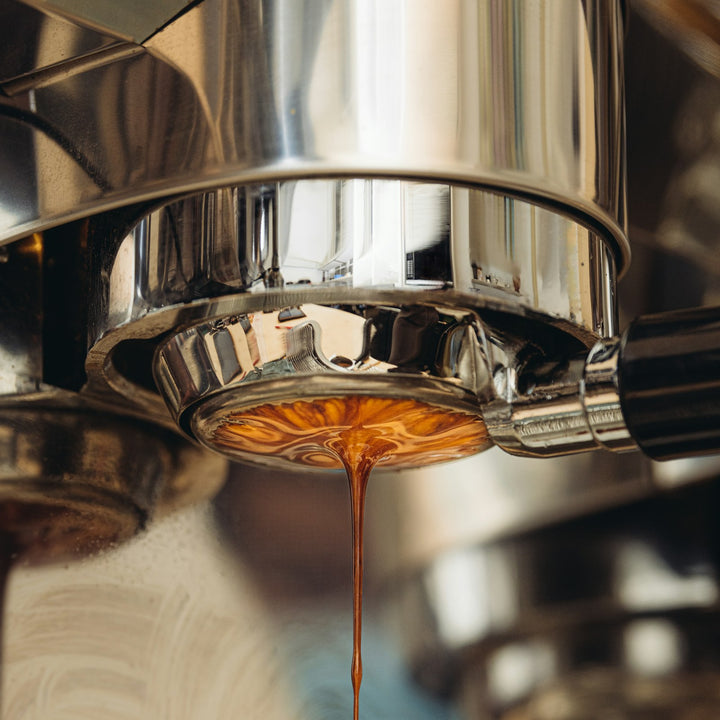
Start with your dose, because everything downstream is a multiple of it. A standard double on our bar starts at 18 grams in the basket and 36 grams in the cup, pulled in about 28 seconds. There are 454 grams in a pound, which puts you at roughly twenty-five doubles to the pound.
So the weekly espresso figure is three numbers multiplied together: your dose, your espresso drinks per day, and your open days.
- 100 espresso drinks a day at 18 grams is 1,800 grams, just under four pounds.
- Six days of that is 10,800 grams, or about twenty-four pounds a week.
- Five days of the same volume is twenty pounds. Seven is twenty-eight.
Run your own numbers rather than mine. And notice what the dose is doing in that sum, because it is the input people treat as a detail. One gram on the dose, across a hundred drinks a day, six days a week, is six hundred grams a week and something close to seventy pounds a year. That is not a rounding error — it is a case of coffee. If your bar has never agreed on a dose in writing, the weekly figure you are about to calculate has a seventy-pound band of uncertainty sitting inside it, and the fix costs nothing but a conversation and a scale.
Why does batch brew add up faster than it looks?
Batch brew is the half of the calculation that gets counted last and is often the one that moves the number most, because you never stand and watch it the way you watch a shot.
We start drip at 1:12, which is four points stronger than the ratio most people expect and stronger than the fill line on a consumer machine assumes. At 1:12, a gallon of drip coffee takes about 315 grams of ground coffee. That is a bit under three quarters of a pound, per gallon, every time.
Four gallons a day is 1,260 grams, or nearly two and three quarter pounds. Over six days it is close to seventeen pounds a week, and you will not have noticed any of it leaving, because it leaves in a hopper rather than in a portafilter.
Batch size is where the waste hides, and it is a different mistake from batch count. Brewed coffee holds about thirty minutes on a hot plate and about an hour in an insulated airpot, which is a number we publish for hotels and restaurants because it decides their whole morning. It decides yours too. Brewing a bigger batch less often feels like labor saved, and what it actually buys is coffee poured down a drain at the end of the hour.
So the honest way to count drip is not gallons brewed, it is gallons sold, plus whatever your holding discipline costs you. A bar brewing four gallons across the day in six small batches and selling almost all of it has a very different order from a bar brewing four gallons in two large ones and dumping a third. Same seventeen pounds on the invoice — two different businesses.
If you have never measured which one you are, measure it for a week before you size an order around it. Count what you brew and count what you dump, on paper, every shift. It is the least glamorous week of data a cafe can collect and it is usually the one that changes the order.
Put the two halves together and the example bar is at forty pounds a week. Eight five-pound bags. That is a shelf, not a cupboard, and it is worth knowing before you plan where the coffee is going to live.
If you run drip weaker than we do, scale it down honestly rather than hopefully. The ratio you actually brew at is the ratio that buys the coffee.
What does the coffee you never sell add up to?
Two line items never appear in anybody's projection, and both of them are real pounds.
The first is dialing in. Every time a new coffee lands, somebody has to find it. We publish what that costs on our own wholesale page for cafes: fifteen to thirty shots to land it, plus milk drinks to confirm it holds, which is 300 to 600 grams at a 19 gram dose, and closer to a full two-pound bag once you add the following week's corrections. A cafe rotating a single origin every month is therefore spending something like two pounds a month on coffee no customer ever pays for, and that is the cost of having a rotating single origin, not a sign that anything went wrong.
The second is decaf. Decaf is the coffee whose volume is smallest and whose waste is largest, because of how it gets ground. If decaf runs through the espresso grinder, every decaf order needs a purge first, which is either coffee in the knock box or a decaf that is not actually decaf. Neither is a good outcome, and the second one is the kind of thing a guest tells other people about. Two grinders is the floor once you carry decaf, and a third for batch brew if the counter allows it. The grinder is the fix; the purge is what you pay until you buy it.
Neither of these is large on its own. Together they are the difference between an order that runs out on a Friday and one that does not.
What size bag should those pounds arrive in?
Here is where the arithmetic turns into a decision, and where cost per pound is the wrong thing to optimize.
Bag size is a freshness question wearing a price tag. A five-pound bag is cheaper per pound than a two-pound bag, and that is exactly the trap we warn our restaurant accounts about: order decaf in five pounds and the bag sits open across a month. Our own guidance for cafes is to take two pounds for the coffees that move slowly, whether that is a rare lot sold by the cup, a decaf that gets ordered but not constantly, or a pour over option that turns over inside a week without ever finishing five pounds while it is still fresh.
So run the weekly figure per coffee rather than in total. The bar in the example is a forty-pound-a-week cafe, but it is not one forty-pound coffee. It might be twenty-four pounds of espresso, fourteen of drip and two of decaf, and those three want different formats even though they arrive on the same day.
The test is simple. Take each coffee's weekly poundage and ask how long the largest bag you are considering stays open. If the answer is more than about a week for a coffee you are proud of, buy the smaller bag and stop counting pennies against a cup you are going to apologize for.
Does the retail shelf count toward the same number?
It does, and it is the one part of this arithmetic that works in your favor rather than against you.
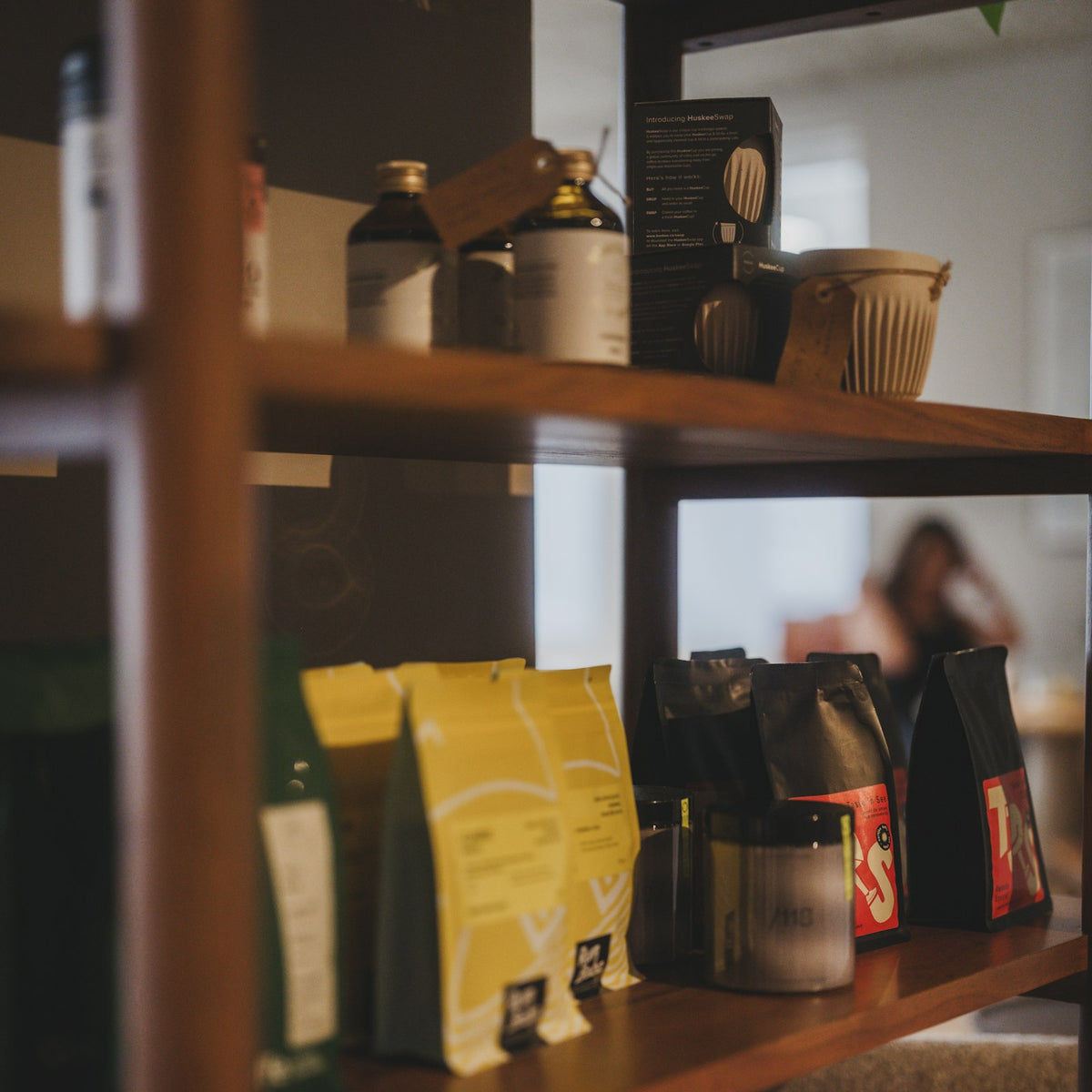
A coffee shop that sells whole-bean bags on a shelf by the register is running two coffee businesses out of one order. It is easy to keep those in separate columns: the bar buys ground coffee to brew, the shelf buys retail bags to sell, and neither column looks big enough to interest a roaster. Counted together, they usually are. Your brewed coffee and your resale bags are one volume rather than two small ones, and that is worth knowing before you decide the shelf is not worth stocking.
It also changes the freshness math in a direction people do not expect. A retail bag sits on your shelf, not in your hopper, so it has to still be good on the day somebody buys it rather than on the day it arrives. A shelf that turns slowly wants small bags and few of them, which is the same rule as the slow-moving espresso lot and for the same reason. The difference is that a stale bag on the bar costs you one bad cup, and a stale bag on the shelf goes home with somebody who then decides what your coffee tastes like in their own kitchen.
Count the shelf. Then stock it like it is being judged later, because it is.
When does the order actually have to be placed?
This is the part that catches new accounts, and it caught them here before we started saying it out loud.
We roast to order every Wednesday in Pensacola. Your order joins a roast rather than coming off a shelf, which is the whole reason the coffee is as fresh as it is, and it has a cost attached that I would rather put in the first conversation than the fourth. The cost is flexibility. A week of lead time is what catches new accounts out in the first month, and it is the trade we have chosen deliberately: we do not hold finished stock so that nothing you get is old, and the price of that is that a Thursday panic cannot be solved by us on Thursday.
Which makes the reorder trigger the important number, not the order size. Our own office accounts taught us this one: people reorder when the last bag opens, and the last bag opening is already too late. Set the trigger at the second-to-last bag and order against the roast day rather than against your own inventory anxiety. On a forty-pound week with five-pound bags, that means your trigger is sitting at ten pounds on the shelf, which sounds like plenty right up until you count the days.
Write the trigger down somewhere that survives staff turnover. A number in one person's head is not a system, it is a single point of failure with a name.
Is your number big enough to be worth a wholesale account?
Sometimes the honest answer is no, and this is the concession I will make before anyone has to ask for it.
We publish no minimum order. That is deliberate and I still think it is right, because a minimum is a way of making a small account feel like a problem. But no minimum is not the same as every volume making sense. A wholesale account only earns its place once you go through enough coffee that wholesale genuinely beats retail for you, and if you run the arithmetic above and land at six pounds a week, you are probably better served by buying retail bags and keeping your cash free.
The other honest limit is at the top. If you are buying by the pallet with price as the only variable, a national supplier will beat us, and you should buy from them. What we are good for is the middle: a cafe whose volume is real, whose coffee needs to be fresh on the bar rather than merely cheap on the invoice, and who would rather have the roaster's phone number than a rep's.
Run the numbers first. Then you are having a conversation about a coffee program instead of a conversation about a price list, and those go very differently.
Key takeaways
- A pound of coffee is about twenty-five double shots at an 18 gram dose, so espresso volume is dose multiplied by drinks multiplied by open days.
- At a 1:12 drip ratio, a gallon of batch brew takes about 315 grams, and four gallons a day is nearly seventeen pounds a week on its own.
- One gram on the dose, at a hundred drinks a day six days a week, is roughly seventy pounds a year.
- Dialing in a new coffee costs 300 to 600 grams, and closer to a full two-pound bag once the following week's corrections are counted.
- Size the bag per coffee, not in total: buy the format that finishes while the coffee is still fresh, even when the larger bag is cheaper per pound.
- Count your retail shelf in the same volume as your bar; together they are usually a real order rather than two small ones.
- Set the reorder trigger at the second-to-last bag and place it against your roaster's roast day, not against the day you notice.
The weekly figure is the easy half. Knowing which coffee it belongs to, what size it arrives in and which day it has to be asked for is the half that keeps a bar running.
Getting your coffee from us. Inheritance supplies cafes across the Gulf Coast on a standing wholesale order, roasted to order every Wednesday in Pensacola and ground free to whatever brewer you already run. Bring your weekly poundage, what you brew on, and your delivery address to wholesale coffee for cafes or apply to serve Inheritance, and we will size the first order with you rather than guess it. If you want to see the same arithmetic run for a different room, we publish it for offices and for restaurants as well, and more of this kind of thing sits under running a coffee program.