Arabica coffee futures rose on Monday 16 November 2026 as the stock of arabica held in ICE-licensed warehouses fell to 211,321 bags, the lowest in 27 years, Reuters reported in a London market story carried by Business Recorder. The most active contract was up 0.7 percent at US$2.7545 a pound at 11:45 GMT, and a later version of the same Reuters report, published by Arab News Pakistan on 17 November, put it at US$2.7470 at 17:12 GMT. Neither version gave a settlement price for the day, and we found none published elsewhere by the time we wrote this.
Reuters said in the same 16 November story that the stock figure had fallen 15 percent over the previous two sessions. Dealers quoted without names in that 16 November report said the drop was keeping prices buoyant for the moment, and added that they still expected stocks to recover because prospects for Brazil's crop remained positive. That is their forecast, not a measurement.
How far did arabica fall before the rebound?
The rise came after a week in which the contract fell and then rebounded. December arabica settled at 273.60 US cents a pound on Monday 9 November, down 6.40 cents, according to World Coffee Index's weekly market recap of 14 November, and on Wednesday 11 November it touched 262.15 cents, which that recap and Reuters' same-day report both called a six-week low. Reuters' later story described the trough as a seven-week low and placed it on the Thursday; we use the date and figure reported on the day itself.
The outlets do not agree on how to measure that low. Comunicaffe, writing from Milan on 13 November, said the December contract closed at 269 cents on 11 November and called that the lowest level since mid-June. We could not reconcile the two descriptions from the published figures.
Why did arabica jump on 12 November?
On Thursday 12 November December arabica closed at 280.20 cents, up 11.20 cents or 4.16 percent, on the day December options expired, World Coffee Index reported. Comunicaffe reported the same close and set it beside a fall in certified stocks, from 250,241 bags on Wednesday to 228,586 on Thursday. At 280.20 cents, a 60-kilogram sack, which is about 132 pounds, works out to roughly US$370 of coffee on paper by our arithmetic.
The gain did not hold through Friday. World Coffee Index said the contract eased to about 274 cents on 13 November and finished the week at 273.94 cents, down 2.16 percent. In London, January robusta ended the week at US$3,207 a metric ton, down 1.93 percent, the same recap reported. On Monday 16 November Reuters had robusta down 0.7 percent at US$3,173, near its recent two-and-a-half-year low of US$3,140.
What are ICE certified coffee stocks?
Certified stocks are coffee that has been graded and approved for delivery against the futures contract and sits in exchange-licensed warehouses. When the pile shrinks, less coffee is on hand to settle contracts. The 211,321 bags Reuters reported come to roughly 12,700 metric tons by our arithmetic, less than two-thirds of one day of world exports at the pace of 123.93 million bags the ICO recorded for the 2025/26 coffee year.
The figure undercuts the previous low of 217,646 bags set on 15 September, according to Barchart's 6 November market report, written by Rich Asplund. Coffee is also queuing to join the pile: Reuters reported 166,456 bags pending grading at ICE warehouses in its 16 November story, and Comunicaffe reported 141,194 bags pending on 12 November, all of Brazilian origin and held in Antwerp.
The International Coffee Organization's monthly report recorded the decline too. The ICO's Coffee Market Report for October 2026 said US certified arabica stocks fell to 0.23 million bags at the end of October, from 0.26 million at the end of September, the lowest month-end level since January 2002. London robusta stocks moved the other way, rising 29.9 percent to 1.13 million bags, the highest since July 2025, the same report said. ICE's own certified-stock report did not load when we tried to read it on 17 November, so the daily figure rests on Reuters.
What do traders say about the next Brazilian crop?
Traders and researchers published different readings of it that week. Sucafina said crop conditions for 2027/28 "continue to look good," Reuters reported on 11 November. Two days later Comunicaffe reported that Alysson Fagundes of Fundação Procafé, speaking at International Coffee Week in Belo Horizonte and quoted by Notícias Agrícolas, said problems in the field could cut the next harvest's potential by around 1.5 million bags even without more bad weather. That is an estimate; Comunicaffe's report said firmer numbers would not come until January. We covered the flowering reports from the same week in our story on Brazil's 2027 crop.
The ICO's daily indicator prices, from its November table, show the same week in physical-market terms, in US cents a pound:
- ICO composite indicator: 247.37 on 9 November, 245.15 on 11 November, 249.09 on 12 November and 249.32 on 13 November, according to the ICO.
- Brazilian Naturals: 276.55 on 9 November and 280.49 on 13 November, according to the ICO.
- Robustas: 159.25 on 9 November and 155.75 on 13 November, according to the ICO.
- Certified arabica stocks: 211,321 bags, reported by Reuters on 16 November; previous low 217,646 bags on 15 September, according to Barchart.
This week's rebound follows the slide we reported in arabica's fall to a five-week low on 5 November, and it is still priced in cents a pound on the contract that ICE's new metric contract is set to replace.
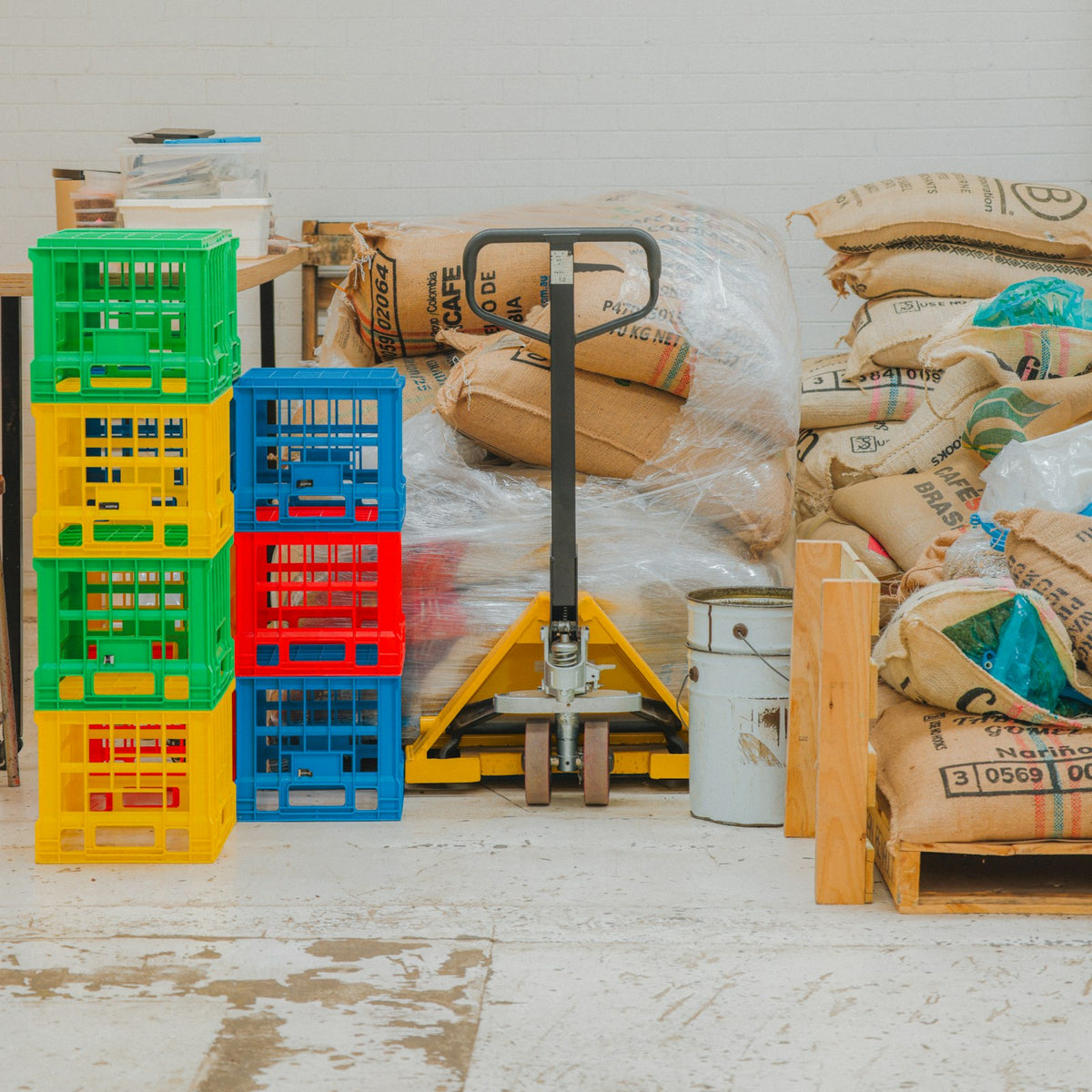
Photograph: Jason Don, Unsplash. Sacks and crates in a coffee warehouse in Melbourne; not an ICE-licensed warehouse.