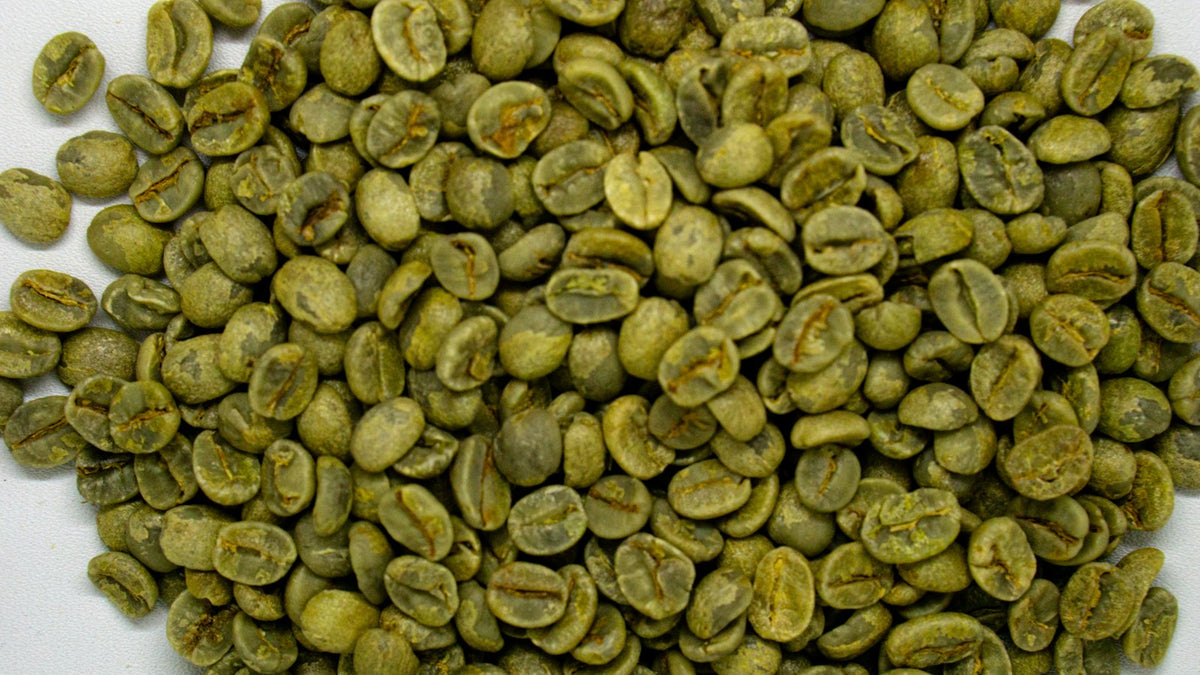
Chlorogenic acid is not one compound. It is a family of esters, each one a hydroxycinnamic acid (mostly caffeic acid, sometimes ferulic, p-coumaric, or sinapic) bonded to quinic acid, and green coffee carries more of it than almost any other food plant grown for human consumption. A typical green bean runs somewhere around 34 to 42 milligrams of it per gram. By the time that same bean has been roasted, the figure is usually down to single digits. Something happens to nearly 90 percent of it, and it does not simply burn away.
Key takeaways
- Chlorogenic acid is a family of esters formed when a hydroxycinnamic acid, mostly caffeic or ferulic acid, bonds to quinic acid. Coffee carries an unusually high amount of it compared with most other food crops.
- Green coffee measures roughly 34 to 42 milligrams of total chlorogenic acid per gram. Roasted coffee measures roughly 2 to 7 milligrams per gram, a loss on the order of 90 percent.
- Roasting does not just destroy chlorogenic acid. Heat first shuffles the acyl group between quinic acid's attachment points, then forms a family of lactones, then hydrolyzes some of those lactones back down into free quinic acid and the original hydroxycinnamic acid.
- That hydrolysis is the missing half of something our own What Is Malic Acid in Coffee? article already reported without explaining: the same research found quinic acid rising while chlorogenic acid fell. The chlorogenic acid breaking apart is where the quinic acid comes from.
- The lactones formed along the way, not the original acid, are the main source of bitterness in a light to medium roast. Push the roast further and a harsher class of compound takes over.
What is chlorogenic acid, chemically?
Strip the name down and it describes a bond, not a single molecule. "Chlorogenic acid" is the common name for a group of esters built the same way: a hydroxycinnamic acid, usually caffeic acid, attached to quinic acid. A 2017 review in Natural Product Reports by Clifford, Jaganath, Ludwig, and Crozier counts more than 400 distinct chlorogenic acids reported in the scientific literature, though the handful built on caffeic and ferulic acid, known as the acyl-quinic acids, are the ones that actually matter in a cup of coffee.
Coffee is one of the richest dietary sources of this compound family that exists. The plant builds it as part of its own chemical defenses, and the green bean concentrates it well above the level found in most fruits and vegetables anyone eats on purpose.
What roasting actually does to it
Clifford's review puts a number on the overall loss: acyl-quinic acid content can fall by around 90 percent between green and roasted. The more interesting finding is what replaces it, because the chemistry does not reduce to zero.

The quantities involved were measured directly by Moon, Yoo, and Shibamoto in a 2009 paper in the Journal of Agricultural and Food Chemistry. Across seven commercial green coffee samples, total chlorogenic acid ran from 34.43 to 41.64 milligrams per gram. Across seven commercial roasted samples, it ran from 2.05 to 7.07 milligrams per gram. In their own roasting experiment, beans held at 230°C for 12 minutes, a lighter roast, still carried about half of their original chlorogenic acid. Beans carried to 250°C for 21 minutes, a much darker roast, came out close to zero.
Where did the rest of it go? Not up the exhaust. Clifford's review traces three things happening at once. First, acyl migration: the ester bond moves between quinic acid's three attachment points, so the form that dominates in green coffee gives way to two other forms as roasting proceeds. Second, lactonization: heat drives off a molecule of water and welds the ester into a ring, producing chlorogenic acid lactones such as 1-O-caffeoylquinic-1,5-lactone. Third, hydrolysis: continued heat breaks some of those lactones, and some of the original esters, apart entirely, releasing free quinic acid and the original hydroxycinnamic acid. That is, counterintuitively, why the number of distinct chlorogenic-acid-family compounds a lab can detect actually rises during roasting, from around 72 in green beans to more than 200 in roasted ones, even as the total mass of the whole group falls by about 90 percent. Roasting is not simple destruction. It is one compound family breaking into many smaller pieces, some of which stick around longer than others.
Where the bitterness actually comes from
This is also where a good deal of coffee's bitterness gets made, and it happens in two stages rather than one. In 2007, a team led by food chemist Thomas Hofmann at the Technical University of Munich traced coffee's bitterness to two separate compound classes, presented at that year's American Chemical Society national meeting and reported at the time by ScienceDaily. Chlorogenic acid lactones, the first product of roasting described above, were identified as the dominant source of bitterness in a light to medium roast. Push the roast further and those lactones break down in turn into phenylindanes, which carry a harsher, longer-lingering bitterness and show up at higher levels in dark roasts and espresso.
None of this means chlorogenic acid itself is what anyone tastes as acidic in the cup. Our own What Is Malic Acid in Coffee? article already covered the sensory research on that point: individual acids in brewed coffee mostly sit below the concentration at which a taster can pick them out by name, and nothing about chlorogenic acid's chemistry argues otherwise. What chlorogenic acid does instead is set the roast's chemistry in motion. It is the raw material the bitterness story runs on, not the bitterness itself.
What this cost us to admit
We have written "malic acidity" on six pages of this site, and said so plainly in the article that covers it. We have never once written the words "chlorogenic acid," on a product page or anywhere else, and researching this piece is the first time anyone here has actually sat with the number: a light roast coffee can be carrying something like ten times the chlorogenic acid of a dark roast of the exact same lot, and almost none of that difference is something we chose to measure or report. We buy green, we pick a roast curve by taste and by the cupping table, and the compound doing more than almost any other to separate a light roast from a dark one has never appeared in our own copy until this sentence.
That is not a confession of doing anything wrong. Roasting by cup and by curve, not by lab assay, is how almost every roastery our size operates, and no chromatograph was ever going to out-taste Mason's own cupping sheet. It is a confession that the vocabulary we reach for (bright, clean, heavy, round) describes the far end of a chain of chemistry we had not actually looked at until now.
Questions we get about chlorogenic acid
Is chlorogenic acid the same thing as what makes coffee taste acidic?
No. The acids most responsible for perceived brightness in a cup are mainly citric and malic acid, covered in our What Is Malic Acid in Coffee? article. Chlorogenic acid is a different, much larger compound, and it does most of its work by breaking apart during roasting rather than by surviving into the cup.
Does light roast coffee have more chlorogenic acid than dark roast?
Yes, substantially more. Measured directly, coffee roasted to 230°C for 12 minutes retained roughly half its original chlorogenic acid, while coffee roasted to 250°C for 21 minutes came out close to zero.
Is chlorogenic acid what makes coffee taste bitter?
Not directly. Research out of the Technical University of Munich found that chlorogenic acid lactones, formed when chlorogenic acid breaks down during roasting, are the main source of bitterness in a light to medium roast. A further breakdown product, phenylindanes, takes over in dark roasts and espresso.
Why do coffee companies talk about chlorogenic acid as a health compound?
Because green coffee is one of the richest dietary sources of it, and it has been studied as an antioxidant. We are a roastery, not a research lab, and we are not going to make a health claim here that belongs to a nutrition scientist rather than to us.
The coffee. If you want to taste coffee near the top of this curve, Kenya Kiambu is roasted light, specifically to stop before the chlorogenic acid has finished breaking down. SL-28 and SL-34 from Kiambu County, cupping 91.5. Roasted to order in Pensacola every Wednesday and shipped within 1-2 business days of the roast.