At an event in Los Angeles, on my first coffee cart, I got the espresso machine up to temperature, laid out the cups and lids, and realized I had left my tamp at home. I was about twenty. What saved the morning was the lid off the five-gallon water jug, which fit the portafilter almost exactly. I packed every shot with it and worked the event, and nobody who ordered a drink knew anything had gone wrong.
The reason a jug lid can stand in for a tamp is the same reason immersion brewing is a different animal. Espresso pushes water through a packed bed, so the bed has to sit level, or water finds the loose spot and leaves the rest barely touched. All a tamp does is make the bed flat. Immersion brewing has no bed at all. The grounds and the whole volume of water sit together for the length of the brew, and the water you pour in is the water you pour out.
Which brewers are immersion brewers?
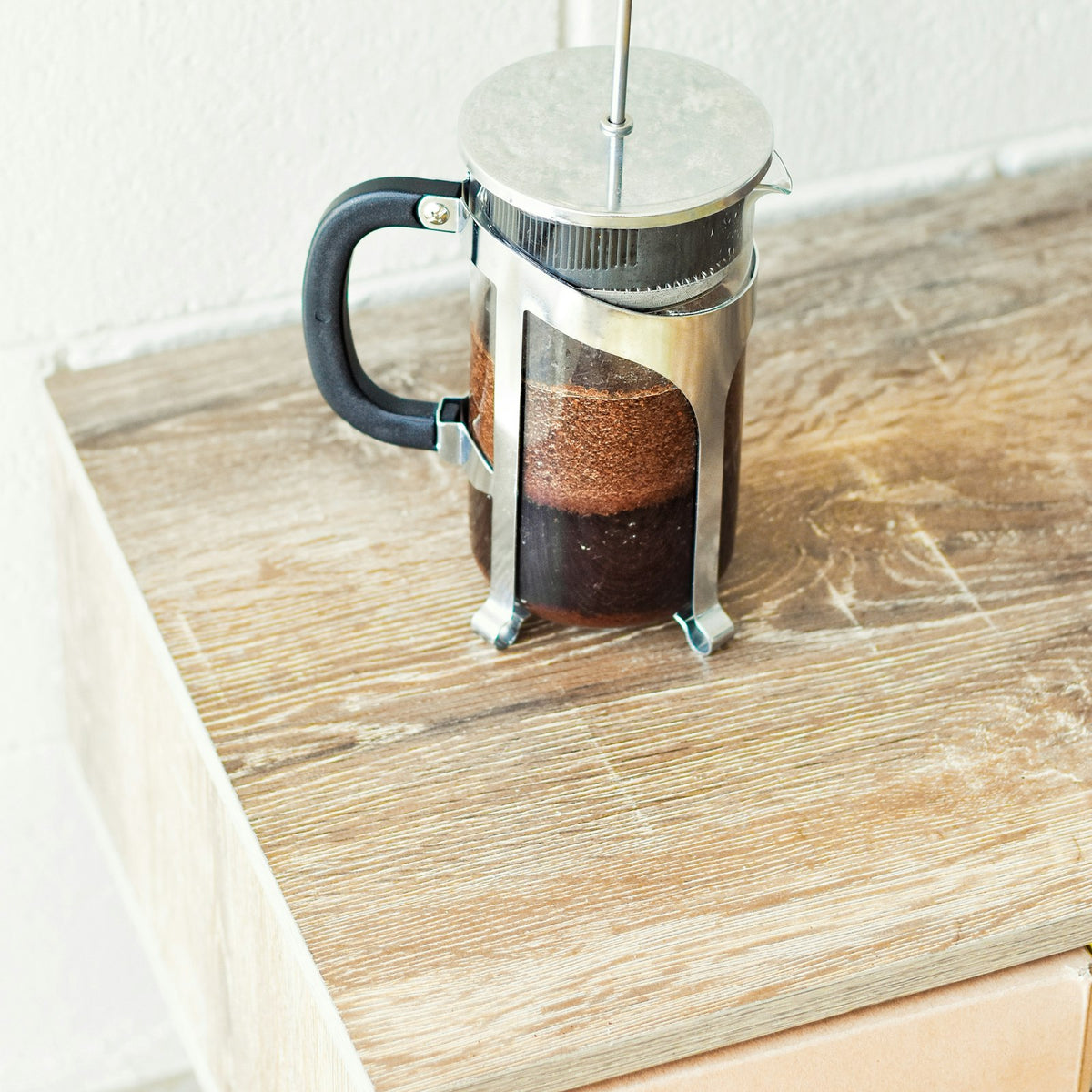
A French press, a jar of cold brew, a cupping bowl on our tasting table — anything where the coffee is submerged and stays submerged until you separate the two. Two sit on the fence: an AeroPress steeps then adds pressure, a Clever dripper steeps then releases through paper.
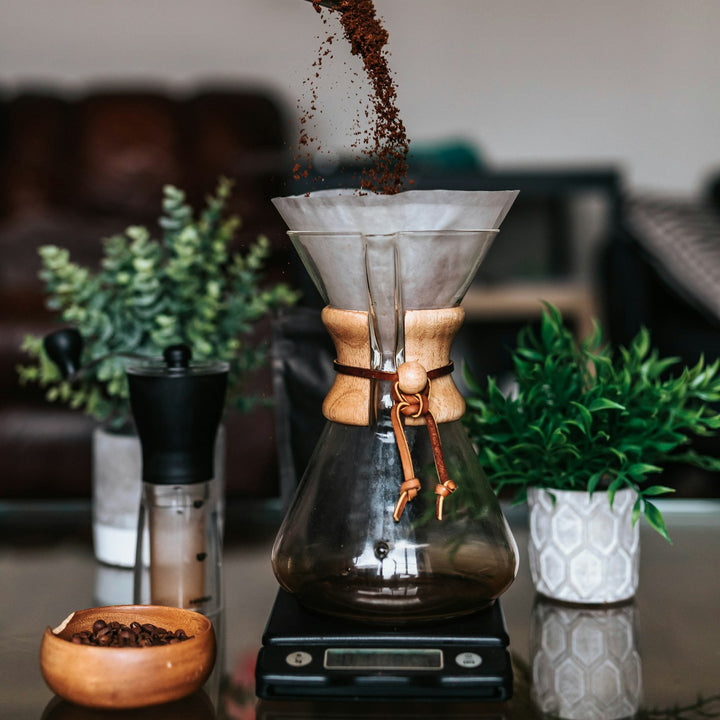
Everything else on a home counter is percolation: water passes through the grounds once and keeps going. A V60, a Chemex, the office drip machine, espresso at the far end. The mechanical consequence is not ours and we did not find it. Writing for Perfect Daily Grind in March 2019, Sierra Burgess-Yeo set it out, citing Matt Perger: extraction in a percolation brew is "a little more efficient than immersion brewing, due to the constant flow of water." Fresh water keeps arriving, so the coffee never stops giving. In a press the water gets closer and closer to carrying all it will carry, and the brew more or less stalls. Sweet Maria's keeps a good library on individual brewers.
Does immersion brewing make a heavier cup?
Measured as thickness, no. We published the numbers in our piece on what body in coffee actually is. Angeloni and colleagues, in Food Research International in 2019, ran eight brewing methods through one capillary viscometer at 20 degrees Celsius. Against water at the same temperature, a French press came in around 0.98, a V60 around 1.00, cold brew around 1.01, an AeroPress around 1.02. The press, with the heaviest reputation of the eight, measured thinner than the pour over it supposedly outweighs. One caveat travels with that: the press also had the lowest dissolved solids of the eight, 1.35 percent against the V60's 1.55, so some of the gap is concentration rather than mouthfeel.
What you are tasting instead is the filter. Orrje and colleagues, in Nutrition, Metabolism and Cardiovascular Diseases in 2025, measured median cafestol, one of the coffee oils: 11.5 milligrams per liter for paper-filtered drip, 87 for a French press, 91 for a percolator. Pour one boiled coffee through a cloth and the figure drops from 939 to 28. Same coffee, same brew, and fabric removed almost all of it. That is the real axis between a press and a pour over — what the mesh lets through, rather than how long the coffee sat in the water.
Why does immersion brewing need a coarser grind?
Because grind is doing a different job in each family. In a percolation brew, grind size sets how fast water moves through the bed, so it controls contact time, which is why a finer grind changes a pour over as much as it does. In an immersion brew there is no flow to regulate. The clock decides contact time, and all grind sets is surface area. Go too fine and nothing slows the extraction, and the fines walk through a metal mesh and keep working in the cup. So a press hands you two dials, the grind and the clock, which is why your ratio and the water you brew with carry more of the result here than anywhere else.
Which coffee should you use for immersion brewing?
Here I have to concede something about our own record rather than about coffee. Every bag we sell carries a brew-suitability field, and it publishes three values: espresso, drip and cold brew. Cold brew is the only immersion value in it, and the two coffees that ever carried it are archived and out in every size. So everything you can buy from us today reads espresso or drip, and our label cannot tell you what belongs in a press. That is a hole in our taxonomy, not a claim about coffee.
What I would tell you is simpler. Immersion leaves fewer places to hide, because you cannot chase a dull coffee with a better pour. Pick something with enough going on that a flat extraction still tastes like something, grind coarse, give it four minutes, and judge the coffee rather than your own hands. More is in our brewing and gear guides.
If you want one to start with: our Ethiopia Dry Process Hambela Buku cups at 92.3, with strawberry, honeydew and honeysuckle, and it has plenty to give after four minutes in a press. We roast to order every Wednesday in Pensacola and grind to whatever brewer you name, at no charge.