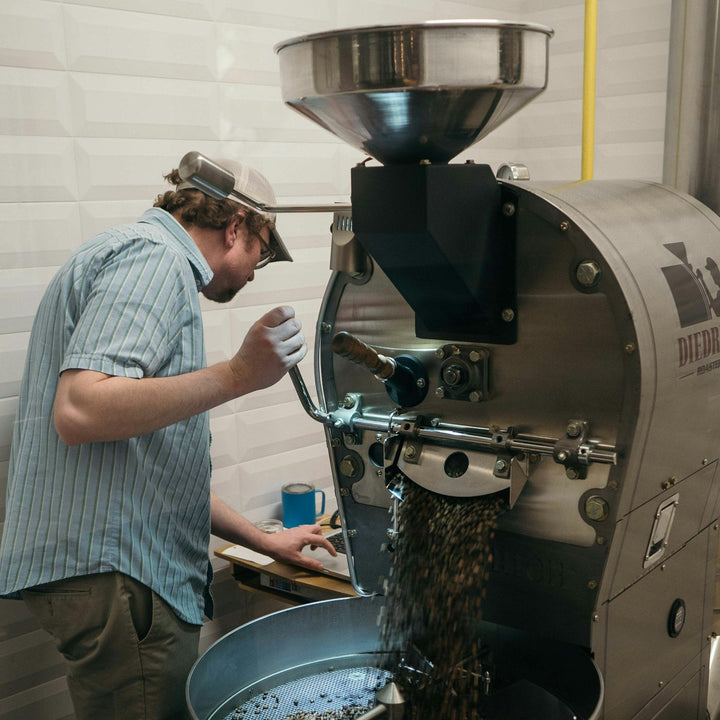
A pan of charred coffee sat on my kitchen counter for a week, and every day a few of the beans would pop like popcorn, fly up out of the pan, and split apart into pieces. I was new to roasting then, and I had taken that batch much further than I meant to. Watching it come apart on the counter taught me the thing that also explains the slick on a bag of dark beans: a roasted coffee bean does not stop changing when it leaves the roaster. What you can see on the outside of it is the inside, on its way out.
Where does the oil on a coffee bean come from?
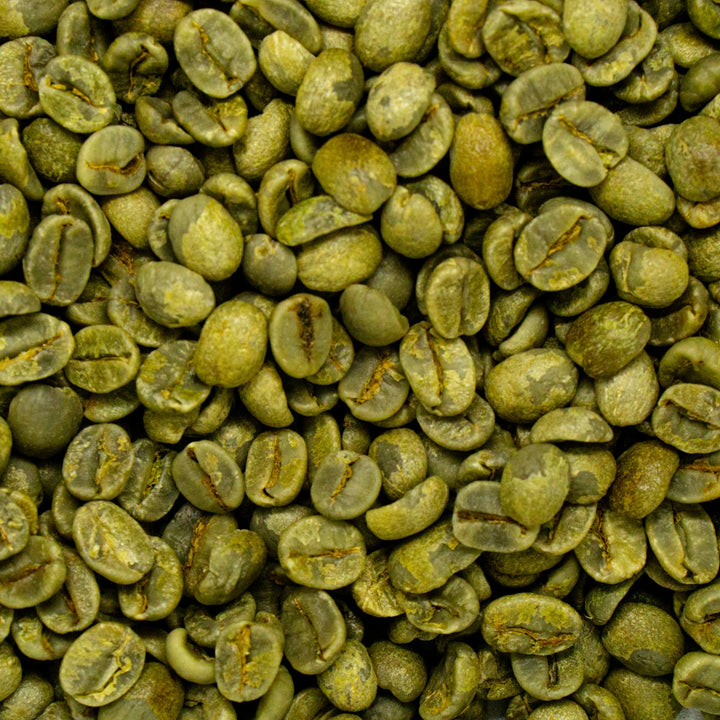
From inside the seed, and it was there long before anybody roasted it. Karl Speer and Isabelle Kölling-Speer's review of the coffee lipid fraction in the Brazilian Journal of Plant Physiology says arabica and robusta beans "contain between 7 and 17 % fat," and that "most of the lipids, the coffee oil, are located in the endosperm of green coffee beans... only a small amount, the coffee wax, is located on the outer layer of the bean." That surface wax runs about 0.2 to 0.3 percent of the bean's weight.
So a green bean can be a sixth fat by weight, and almost none of it starts on the outside. Roasting does not create the oil. It moves it.
Why does the oil move to the surface?
Pressure, through channels you could never see. Perfect Daily Grind published the plain version of this in 2019 and it is correct as far as it goes: "During roasting, the high internal pressure causes these compounds to migrate from the center of the cell towards the surface of the beans." I would send anyone to Veronica Belchior's piece for the rest of the physical changes.
The route is the part worth knowing. Schenker and colleagues measured the pore structure of roasted beans for the Journal of Food Science in 2000 and found it "dominated by small micropores in a very narrow dia range of 20 to 50 nm" — roughly two thousand times narrower than a human hair. Their sentence on what those pores do is the whole mechanism in one line: "Fine micropores allow the mobilized coffee oil to migrate to the bean surface."
That is why a dark roast shows it first. The further a roast runs, the more of the bean's structure has been converted and broken open, and the more gas is pushing outward through it.
Does an oily bean mean the coffee is fresh?
No. It mostly means time has passed.
The beans Schenker's team photographed had a roast loss of 15 percent, "which in practice corresponds to a 'medium degree of roast'" — and the surface images taken "in the state of the beginning oil migration process" already showed "numerous very small oil droplets covering more or less the entire surface." Migration is underway at medium. The visible slick is a late stage of something that starts invisibly, everywhere on the bean at once, and keeps going in the bag.
The same openness that lets the oil out lets oxygen in, which is the part nobody enjoys hearing. Schenker's own introduction ties staling to "the extent of exposure of inner surface and to the oxygen accessibility." A bean wearing its oil on the outside has put its most oxidizable material where the air is.
Here is where we are the wrong roaster to ask. Our Dark Roasts collection is empty. Every coffee on our shelf today grades light or medium, so if a heavy, oily bean is the cup you want, you are buying it from somebody else. We grade roast level with an Agtron score on every batch rather than reading it off the shine, and the reason is this whole article: the shine is a fact about storage as much as it is a fact about the roast.
What should you do with an oily bag of coffee?
Drink it sooner than you would a light roast, and buy it in a size you will finish. Keep the bag closed between uses. Expect it to be harder on equipment than a dry bean is — one of the grinders in our own catalog ships with a manufacturer warning that very oily coffee beans are not recommended for its burrs, and that warning is not marketing.
If the beans went oily in your cupboard rather than arriving that way, that is the clock running, not a roast style. Grinding accelerates it, and so does the rest period every roasted coffee needs before it is at its best, which we covered in how long coffee should rest after roasting. A light roast gets there later because it has less broken structure to work through.
What you are looking at on an oily bean is not how the coffee was roasted. It is how long ago.
Coffee from Inheritance
ASCENT is our medium-roast blend, graded by Agtron like every batch we run, and it is in stock in 250g and 2lb. We roast to order in Pensacola every Wednesday.