A light roast is coffee pulled from the roaster shortly after first crack, before the sugars caramelize far and before any oil reaches the bean's surface. It is not weaker, not more caffeinated, and not a quality grade. Here is what the label actually measures, and what happened in 2024 when researchers finally measured the caffeine.
Key takeaways
- A light roast is defined by when the batch comes off the roaster: shortly after first crack, before second crack and before any oil surfaces on the bean.
- Caffeine barely moves during roasting, but 12 to 20 percent of the bean's weight does, so a dark roast is fractionally more caffeinated per gram and a light roast is more caffeinated per scoop.
- A 2024 study in Scientific Reports measured 134 to 165 milligrams per 8-ounce cup across every roast level, with the highest readings at a medium roast.
- Extraction yield, meaning how much of the ground coffee your brew dissolves, changes the caffeine in your cup more than roast level does, so dose, grind, and brew time are the levers.
- No legal or industry-wide line separates light from medium, so one roaster's light is another's medium, and the origin, process, and cup score tell you more than the label does.
- Kenya Kiambu, a washed lot from Kiambu County that cups 91.5, is the only light roast on our shelf.
What "light roast" actually means
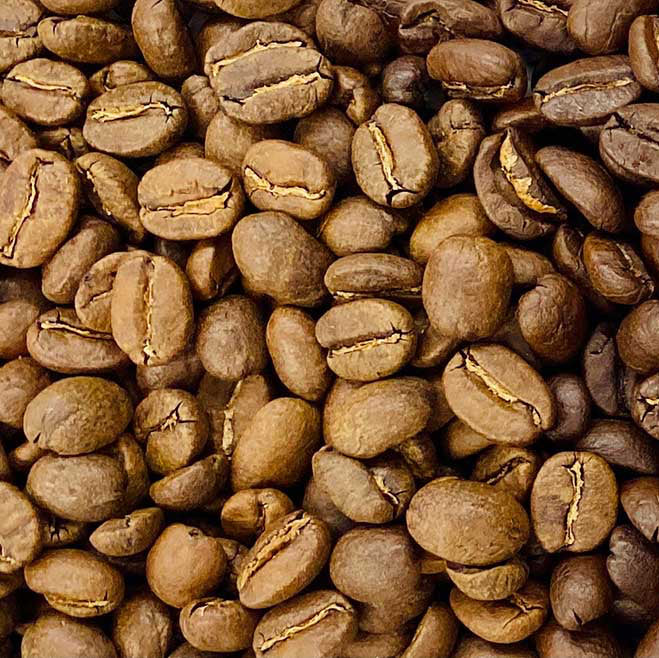
Light is a stopping point, not a style. Every roast runs the same sequence: the bean sheds moisture, browning reactions build sugar and acid into flavor, and the bean fractures audibly at first crack, generally around 380 to 400°F of bean temperature. A light roast comes off the drum shortly after that; a dark roast runs on to second crack, above roughly 440°F, where oils migrate to the surface. Those are general figures for how roasting works, not a profile we publish.
The number that separates them is roast mass loss, the weight a batch gives up in the drum. Less heat time means less loss, a denser bean, and more of the origin's acidity left intact. Our guide to coffee roasting walks through the full curve.
Color is the measurement roasters use, and it is graded on the Agtron scale rather than by eye. We grade every batch with an Agtron score, which turns roast level into a decision with a number behind it. Here is the honest limit: no standard fixes where light ends and medium begins, so one roaster's light is another's medium, and the difference between light and medium roasts is house style as much as chemistry. The origin and process printed on the bag tell you more than the roast label does.
Why roast level is the wrong variable for caffeine
A light roast is not stronger in caffeine. Two things happen in the drum and they pull against each other. A little caffeine does leave the bean, but not in amounts worth noticing until bean temperature passes roughly 400 to 420°F, which is the top of a medium roast and beyond. Far more weight leaves: 12 to 20 percent of the batch, mostly water. Mass goes faster than caffeine does, so a dark roast ends up slightly more caffeinated per gram than a light one.
That inverts the argument most people are having. Weigh out 20 grams of dark roast and you are holding more individual beans than 20 grams of light, each carrying nearly the caffeine it started with. Scoop it instead and the reverse applies, because light-roast beans are denser and a scoop holds more mass. The two effects land close enough together that in the cup it is a wash.
Someone finally measured the cup. Researchers at Berry College and Drexel University roasted two Ethiopian coffees to five roast levels and measured the caffeine in the brewed cup by HPLC, publishing the results in Scientific Reports on 25 November 2024. Across every roast level they found 134 to 165 milligrams per 8-ounce cup. The peak sat at 14 to 16 percent roast mass loss, which is a medium roast rather than a light one. At matched extraction yield, the darker roasts measured higher, not lower.
Their own conclusion: extraction yield plays a more impactful role than the degree of roast alone. If you want more caffeine, the levers are dose, grind, and brew time. The label on the bag is not one of them.
What a light roast tastes like, and when it is the wrong bag
The point of a light roast is that you taste the farm instead of the fire. With less caramelization, nothing roasty sits on top, so what reaches you is acidity, fruit, and whatever the origin and process actually built. Kenya Kiambu is the example on our shelf: a washed lot from Kiambu County that cups 91.5 and tastes of brown sugar, maple syrup, dried tamarind, cranberry, citrus, and clove.
Kiambu County sits between 1,600 and 1,900 metres, and our essay on Kenya as an origin covers why the country's washing stations and grading system produce that structure. The lot is SL-28 and SL-34, the two Kenyan selections behind the country's blackcurrant spine.
Here is where a light roast is the wrong answer. If you take coffee with cream and sugar out of a French press and want chocolate and caramel, a medium roast is the better tool, and it is what most of this roastery does: the bulk of the coffees we sell sit in the medium roast collection.
How to brew a light roast so it isn't sour
The complaint that light roasts taste sour is almost always under-extraction, not the coffee. A denser bean gives up its solubles more slowly, so a recipe tuned for a medium roast pulls short and hands you the sharp front end with none of the sugar behind it. Three adjustments fix most of it:
- Brew hotter, at 200 to 205°F. Water cooler than that will not get into a dense bean quickly enough.
- Grind one step finer than you would for a medium roast, which increases surface area and speeds extraction.
- Give it more contact time, whether that means a slower pour or a longer immersion.
Grind is the setting people get wrong most often, and it is the one we take off your hands. We grind every order to your brewer at no charge, which matters more on a light roast than anything else we sell, because a dense bean punishes a grind that is off.
Where to find light roast coffee
Judge the bag, not the brand. Four things should be printed on it, and finding all four together is rare:
- A roast date rather than a best-by date. A best-by date says when the roaster stopped guaranteeing the coffee; a roast date says how old it is.
- The origin and the process. Washed, natural, or honey changes the cup more than roast level does.
- A cup score. The only number on a bag tied to an independent sensory standard.
- A stated roast level. A roaster who will not name it is asking you to guess.
We publish a cup score on every coffee we sell and roast to order in Pensacola every Wednesday, so a coffee is graded before you buy it and roasted after you order it. The honest caveat: there is exactly one light roast on that shelf, a narrower choice than a specialist retailer gives you.
Questions we get about light roast coffee
Is light roast coffee stronger?
No, though it depends which strength you mean. The word covers two different things: perceived intensity in the cup and measured caffeine. A light roast is lower in roast-derived intensity, with less caramelization and no roast bitterness, and higher in acidity and fruit. In caffeine it is not stronger than a medium or a dark.
Does light roast coffee have more caffeine than dark roast?
Per scoop yes, per gram no, and in practice the two cancel out. Caffeine barely changes during roasting while 12 to 20 percent of the bean's weight burns off, so dark roast beans are less dense and slightly more caffeinated by weight. Researchers measuring brewed cups in 2024 found 134 to 165 milligrams per 8-ounce cup across every roast level.
Is light roast coffee the strongest?
No roast level is the strongest, because roast level is not the variable that decides caffeine. The measured spread across light, medium, and dark in the 2024 Scientific Reports study was about 31 milligrams per 8-ounce cup. Species, dose, grind, and brew method all move caffeine more than roast color does.
What does light roast coffee mean?
It means the batch came off the roaster early, shortly after first crack and well before second crack, so the beans are still dry on the surface with no visible oil. It describes when roasting stopped, not quality or strength. We grade roast color on the Agtron scale rather than judging it by eye.
How much caffeine is in light roast coffee?
Roughly 134 to 165 milligrams per 8-ounce cup, based on the 2024 filter-brew measurements, and that same range covers medium and dark roasts. Your own cup lands wherever your dose, grind, water temperature, and contact time put it. For comparison, a cup of decaf runs about 2 to 5 milligrams.
Which coffee is stronger, light or dark roast?
A dark roast tastes stronger, and a light roast is not weaker, which is the whole confusion. Darker roasts carry roast bitterness and a heavier body that reads as power, while lighter roasts read as bright and acidic. Neither wins on caffeine. To get a stronger cup from either, change the ratio: more coffee, finer grind, longer contact time.
Start with Kenya Kiambu
The argument for a light roast is in the cup rather than in an article. Kenya Kiambu is the one we roast light: washed, from Kiambu County, 91.5 on the cupping table, and built for drip. It is roasted to order in Pensacola every Wednesday, and we grind it to your brewer at no charge, which is the easiest way to keep a dense bean from tasting sour.