I was about twenty, running my first coffee cart business, when I set up for an event in Los Angeles and realized my tamp was still sitting at home. The espresso machine was already heating. I had just finished putting out the cups and lids, the event was about to start, and there was no way to press coffee into a portafilter without the one tool built to do it. I was embarrassed enough to want to hide. Then I noticed that the lid from the five-gallon water jug I'd brought fit the portafilter perfectly, and that is what I tamped with for the whole event. Nobody noticed.
A coffee cart checklist should be built around the things a drink can't be made without, starting with the small hand tools, because those are the items that get left behind and nobody at a venue can lend you one. After the tools come the coffee and the cup, then power and water, then what the venue owes you, and finally the breakdown, which is the half of the list that's easiest to skip.
Why does a coffee cart need a checklist when a cafe doesn't?
Because a cafe's tools live in the building and a cart's tools exist only if somebody put them in the vehicle that morning. A barista who forgets something at a cafe walks ten feet to the back. A barista who forgets something at a cart finds out in a parking lot or a ballroom a long drive from where the cart lives, usually right as the doors open.
Every event starts from an empty cart. That's the difference, and it changes what memory is good for. Knowing what goes into a cart and checking that it's in there are different jobs, and only the second one would have saved me that day.
The tamp wasn't the only time it happened, either. On another occasion an event went out without the portafilter, and that time I wasn't even there. I've written about that one, and what it did to how I think about training, in how to train a new barista. These days nothing leaves for an event until a written list has been gone through a second time. The list is boring. It's supposed to be.
What should go on the list first?
The things with no substitute. Sort every item you carry by one question: if this were missing, could anybody at the venue hand me something that would do the job? Then put everything that fails that question at the top, in bold, where it gets read first.

On an espresso cart that top tier is short and it's almost entirely hand tools:
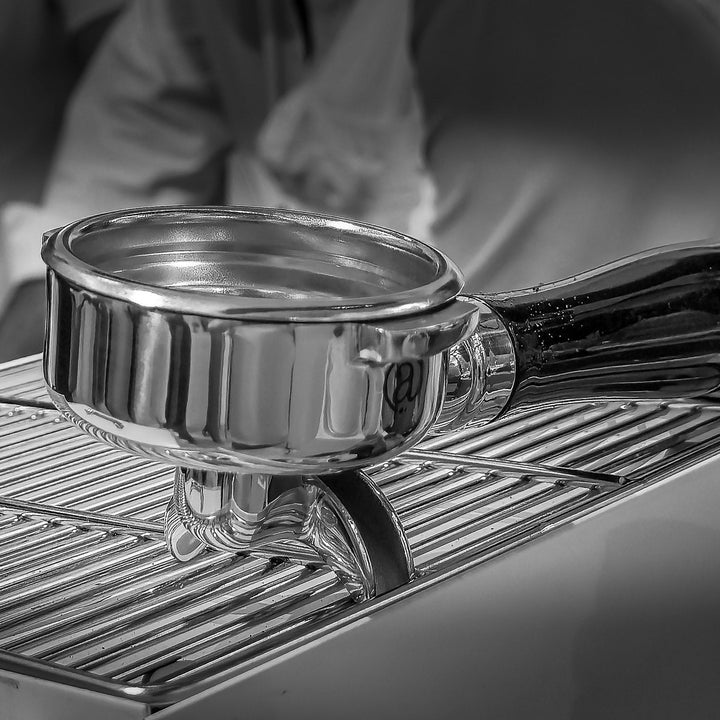
- Portafilters, with their baskets in them. There is no improvising one. Without it the machine has nothing to brew into.
- The tamp. I got lucky once with a jug lid. Luck isn't an item on a list.
- The grinder, and its power cord if it detaches. Pre-ground coffee will make a drink, but not the drink you planned to serve.
- A scale and a shot timer. You can pull shots without them. You can't dial in without them, and the dial-in happens on site.
- Steam pitchers. More than one, in the sizes your menu uses.
- The knock box. A trash can works badly for about an hour, and then it doesn't work at all.
- A group head brush and towels. Clean towels, more than you think, because they're the one thing every barista reaches for constantly.
Everything else can be bought, borrowed or worked around. Cups can come from a store down the road. A pitcher of milk can be fetched. A portafilter cannot be found at a wedding.
The ranking matters more than the length. A list of eighty items read at the same pace from top to bottom is a list where the tamp gets the same half-second as the stirrers. A list where the first seven lines are the ones that end your service is a list that protects you even on the morning you're rushing it.
How much coffee, milk and how many cups should a cart carry?
Enough for the most drinks the bar can physically make, not the number of guests. Those are different numbers, and the bar's number is the one you can actually calculate.
One barista on our cart makes 60 to 75 drinks an hour once the bar is warm. So a two-hour window with one barista has a ceiling of 120 to 150 drinks, no matter how many people are invited. Pack cups, lids and sleeves for that ceiling plus a margin, and the cup count stops being a guess.
Coffee works the same way. The starting espresso recipe we publish uses 18 grams of coffee for a double shot. If every one of 150 drinks were a double, that's 2.7 kilograms, a little under six pounds of whole bean. Not every drink is a double, so that figure is a ceiling rather than a target, which is exactly what you want from a packing number.
On our own cart the consumables cover whole milk plus oat and almond, the syrups on the menu (vanilla, caramel and chocolate as the standard three), and cups, lids, sleeves, napkins and stirrers. Milk is the item where running out costs the most and over-packing costs the least, because it goes back in the cooler and gets used.
What goes on the list for power and water?
An extension cord, every single time, and a question rather than an item: what else is on this circuit?
We carry an extension cord to every event, because the outlet is so often not where the cart needs to stand. The cord is the easy part. The circuit is the part that bites. On a different occasion, also in Los Angeles, I worked a concert with more than 4,000 people there, sharing power with another vendor. Between us we kept tripping the breaker. With about 40 people in my line, I could serve roughly one person every four to five minutes.
No item on a packing list fixes that. What fixes it is a line on the list that says to ask, before the day, which outlet the cart gets and what else draws from it. If the event is outdoors, the site itself becomes the question, and we've worked through that separately in how a coffee cart gets power at an outdoor wedding.
Water is simpler. We bring our own for most events, settled with the venue when the booking is made rather than on the day. That means full jugs with their lids. That day in Los Angeles, it was a jug I'd brought for water whose lid ended up doing a tamp's job.
What should the venue have ready before the cart arrives?
Four things, and every one of them belongs on your list as a confirmation, not a hope: space to set up, a standard wall outlet for each espresso machine, a trash can nearby, and a site contact who can meet the barista at the door.
The site contact is the one people leave off, and it's the one that saves the most time. One name and one phone number, somebody who knows which outlet is live and can answer a question without walking off to find somebody else. Our coffee cart page sets out what we ask venues for in full, and a cart of your own can borrow the same four lines.
Confirm them three weeks out, then once more the day before. A venue that changed rooms on you will tell you if you ask. It rarely volunteers it.
When should the checklist actually be read?
At load-out, before the vehicle leaves. Not at the venue.
That's the whole lesson of the tamp, and I learned it backward. I found out what I'd forgotten after the machine was heating and the cups were out, which is the worst possible moment to find out anything. A checklist read at the venue is just an inventory of what you no longer have.
On our cart the barista arrives about an hour ahead of the service window, and setup runs roughly 45 minutes: the cart rolled into place, the machine onto its outlet and up to temperature, the grinder dialed in against that morning's shots, milk and cups and signage laid out before a single guest sees the bar. That leaves about fifteen minutes of slack. Fifteen minutes will absorb a slow elevator or a locked loading door. It won't absorb a drive home for a tamp.
So the list gets read where the fix is still free, which is the place the cart is packed.
What belongs on the breakdown half of the list?
Everything that makes the next event start clean, because a cart's next morning begins the night before.
- Flush and cool the machine before it's moved. Moving a machine while it's still hot is how people get burned.
- Pack out the milk and every opened product, and decide on the spot what's still usable.
- Take every bit of your trash with you and wipe the floor under the cart. The venue should get its space back the way it handed it over.
- Count the hand tools back in. The portafilter that doesn't come home tonight is the one missing at the next event.
Our own breakdown takes about half an hour after the last drink, with the machine flushed and cooled, milk and product packed out, and everything we generated leaving in our vehicle. The cleaning that happens back at base is its own routine, and the schedule for it is in how often you should clean a commercial espresso machine.
Counting the tools back in is the line that does the most work for the least effort. It turns a forgotten item into a discovery made at eleven at night in your own building, with a whole day to fix it, instead of one made in front of a line.
What does the whole checklist look like on one page?
Something like this, as a starting version to rewrite around your own cart. It's ordered the way it should be read, top to bottom, with the lines that can end a service first.
Can't be replaced on site. Portafilters with baskets, the tamp, the grinder and any detachable cords, the scale and timer, steam pitchers, the knock box, the group head brush.
Coffee and the cup. Whole bean coffee packed for the bar's ceiling rather than the guest count, milk and alternatives on ice, syrups, cups, lids, sleeves, napkins, stirrers, clean towels.
Power and water. The extension cord, full water jugs with their lids, and a confirmed answer about which outlet the cart gets and what else is on it.
Confirmed with the venue. Space, an outlet per machine, a trash can nearby, a site contact's name and number, and the load-in door.
Front of the cart. The menu board and any signage, and a way to take payment if you're charging.
Breakdown. Machine flushed and cooled, milk and opened product packed out, trash taken with you, the floor wiped, hand tools counted back in.
Print it, tape it inside the lid of whatever box the hand tools travel in, and cross things off with a pen rather than with your eyes. A line you physically mark is a line you actually checked. A line you glance at is one you remember checking, which is not the same thing at all and is exactly how a tamp stays home.
Should a church run its own coffee cart or book one?
For one event a year, book one. For a weekly ministry, the checklist becomes your volunteers' job and it's worth building properly.
The honest comparison is between booking a cart for an occasion and buying an espresso machine and training volunteers to run it, which is a much larger and slower commitment. For a one-off event booking is cheaper by a wide margin. Our coffee cart page for churches also makes the case for booking a Sunday or two as a test before anybody buys equipment, because what you learn about lines and take rates is worth having first.
If a church does run its own cart every week, everything above applies, with one addition: write the list for the newest volunteer on the schedule, not the person who built it. The person who built it doesn't need it on a good day. The newest volunteer needs it on every day.
Where are we the wrong people to ask?
We don't build or sell coffee carts. If the question in front of you is which cart to buy, how it's plumbed, or what a health inspector in your county wants to see on board, a cart manufacturer and your local health department are the people to ask, and this list is no substitute for either.
And a checklist won't make an untrained barista into a trained one. It keeps the tools in the vehicle. What happens once the tools are on the cart is a training question, and it's a separate one.
Running your own cart, or would you rather not? If you're running one, the coffee is the item on the list we can actually help with. We roast in Pensacola and supply cafes, churches, restaurants, hotels and offices through our wholesale program, and a cart is worth asking about on the first call. If you'd rather hand the whole list to somebody else for an event, our mobile coffee cart brings the bar, the barista and the checklist with it.